Prediction Markets
Kalshi and Polymarket legality trackers, market-structure explainers and volume reports.
 November 5, 2026
Kalshi's midterm election trading was about 3 percent of its volume. Sports parlays did roughly 23 times as much
Over the 10 days around the midterms Kalshi did more than $1.1 billion in election trading against $25.3 billion in parlays and $6.1 billion in other sports. Election Day was the exception: 17.5 percent of daily volume, but parlays still drew three times as much.
 November 5, 2026
Prediction market liquidity explained: how depth, spread and slippage set what a trade really costs
A Kalshi book showing 71 cents bid and 74 cents ask costs a buyer 1.5 cents a contract before any fee. The worked example: 100 contracts, the fee formula, a round trip that loses about 8 percent, and when a resting limit order beats a market order.
 Live · updated every 5 minutes
Kalshi vs Polymarket odds, live: every shared market side by side, and where the prices disagree
Live prices from both venues on the Fed, 2028, the NBA, NFL, NHL, soccer, the Oscars and Bitcoin, lined up outcome by outcome, with the biggest gaps ranked and refreshed every 5 minutes.
 Live · updated every 5 minutes
2028 presidential election odds, live: the winner and both nominations on Kalshi and Polymarket
Every candidate with a live price for the White House and the Republican and Democratic nominations, on both venues, with American odds.
 Live · updated every 5 minutes
Fed rate decision odds, live: what Kalshi and Polymarket say the Fed will do on December 9
Live prices for every possible decision at the December 2026 and January 2027 FOMC meetings, plus how many cuts traders expect this year.
 Live · updated every 5 minutes
NBA championship odds 2027, live: every team on Kalshi and Polymarket
All 30 teams with live title prices on both venues, implied probability, American odds and the cheaper side, refreshed every 5 minutes.
 Live · updated every 5 minutes
Super Bowl odds, live: every NFL team on Kalshi and Polymarket
All 32 teams with live prices to win Super Bowl LXI on both venues, with American odds to compare against any sportsbook board.
 Live · updated every 5 minutes
Stanley Cup odds 2027, live: every NHL team on Kalshi and Polymarket
All 32 NHL teams with live prices to win the 2027 Stanley Cup on both venues, with American odds and the cheaper side.
 Live · updated every 5 minutes
College football title odds, live: the national championship race on Kalshi and Polymarket
Live prices for every contender to win the 2026 national title, matched across both venues and repriced after each playoff rankings release.
 Live · updated every 5 minutes
Champions League odds, live: every club's chance to win the 2027 final
One of the most traded futures in the world, side by side on Kalshi and Polymarket, with American odds for every club still alive.
 Live · updated every 5 minutes
Premier League title odds, live: who wins 2026-27 on Kalshi and Polymarket
All 20 clubs with live title prices on both venues, implied probability and American odds, refreshed every 5 minutes.
 Live · updated every 5 minutes
La Liga title odds, live: Barcelona, Real Madrid and the rest
How Kalshi and Polymarket split the Spanish title race, with American odds and the cheaper venue for each club.
 Live · updated every 5 minutes
Oscars 2027 Best Picture odds, live: which film wins at the 99th Academy Awards
Every film with a live Best Picture price on Kalshi and Polymarket, and how the two venues disagree as awards season unfolds.
 Live · updated every 5 minutes
NFL MVP odds 2026, live: every contender on Kalshi and Polymarket
Every player with a live MVP price on both venues, with American odds to compare against any sportsbook award board.
 Live · updated every 5 minutes
NBA MVP odds 2026-27, live: every contender on Kalshi and Polymarket
Doncic, Wembanyama, Gilgeous-Alexander and the rest, priced live on both venues, with American odds and the cheaper side.
 November 4, 2026
Democrats won both chambers. Here is what a Democratic Congress can and cannot do to Kalshi and Polymarket, and when
Democrats take the House and 54 Senate seats on January 3, 2027. Two ban bills are filed, four committee gavels change hands and the CFTC has one commissioner; a veto and the 60-vote rule stand between that and a ban.
 November 4, 2026
Midterm 2026 scorecard: prediction market favourites won 8 of 9 called Senate races, the sweep contract went from 74 to 99 cents, and South Carolina was the miss
Democrats flipped seven Senate seats on November 3. Of nine races called by 11:30 p.m. ET, the Polymarket favourite won eight; Darline Graham at 69.5 cents was the miss. The sweep contract moved from 73.5 to 98.7 cents one to three hours before the network calls, on $1.4 billion of Kalshi volume.
 November 4, 2026
How does Polymarket work? Shares, prices, fees, resolution and payouts, with a worked example
Yes and No shares that pay $1, an order book priced in cents, taker fees from zero on geopolitics to 7 percent of p(1-p) on crypto, UMA resolution with a $750 bond and a two-hour window, and how Polymarket US differs. A $40 trade worked through.
 November 4, 2026
Is Polymarket legal in Vermont?
Polymarket US is live in Vermont from 18 with no state letter, suit or order. Vermont signed the 41-AG CFTC comment and the 39-state Supreme Court brief, sets 21 for its three sportsbooks, and sits in the Second Circuit with New York and Connecticut, both of which have moved against Polymarket.
 November 3, 2026
Election Day 2026: Kalshi and Polymarket go into the vote at 74 to 78 percent for a Democratic Senate, 94 percent for the House, and more than $1.4 billion traded
Kalshi priced a Democratic Senate at 74 percent and the House at 94 percent on November 2; Polymarket traded at 77.5 and 94.5 cents early on Election Day. Kansas moved 24 points in a week. Kalshi reports $1.2 billion in midterm volume, CNN counts $1.4 billion across platforms.
 November 3, 2026
Is Polymarket legal in Washington, DC?
Polymarket US trades in the District with no letter, suit or geofence against it. DC's betting age is 18, so New York's age argument does not apply; its only act is a signature on the 39-state Supreme Court brief of October 7.
 November 2, 2026
Implied probability converter: turn any odds or cent price into a probability, then take the vig out
Enter American, decimal or fractional odds or Kalshi and Polymarket cent prices for up to four outcomes and get the implied probability, the overround and the no-vig fair price in every format.
 November 1, 2026
DraftKings, FanDuel and Fanatics pulled event contracts from Utah within a week of the Kalshi charges. A federal judge sees the CFTC on November 6
DraftKings and FanDuel dropped sports, political and novelty contracts for Utah customers within 48 hours of the Kalshi charges; Fanatics leaves the state on November 4. The CFTC has asked Judge Shelby to stop Utah's cases.
 October 31, 2026
Kalshi raised $1 billion at a $40 billion valuation, a day after Utah charged its founders. Here is what the numbers show
The Series G prices Kalshi at $40 billion post-money, up from $22 billion in May and $5 billion a year ago. Kalshi says it runs at more than $1 trillion in annualized volume. Those figures are self-reported, and the legal map got worse the same week.
 October 31, 2026
Kalshi withdrawal times and limits: bank, debit card, crypto, PayPal and the holds that decide when you get paid
Kalshi charges no withdrawal fee. Debit card payouts usually land within hours, crypto in about 30 minutes, bank transfers in a few business days. A deposit hold of up to 2 days applies if you cash out by a different method.
 October 30, 2026
Two senators from opposite parties gave Kalshi and Polymarket until Election Day to explain how they stop insider trading on the midterms
Elizabeth Warren and John Curtis asked Kalshi and Polymarket for their election insider trading safeguards and CFTC referrals by November 3. The letter has no legal force, but it lands in a month Kalshi reportedly traded about $65 billion, and on the day Utah charged its founders.
 October 30, 2026
Polymarket deposits explained: USDC, Polygon, pUSD, minimums and who pays the fees
Polymarket charges no deposit fee. The US app takes cards, PayPal, Venmo, bank and wire; polymarket.com converts crypto to pUSD on Polygon, with $20 (Ethereum) and $3 (Solana) minimums. Network, bridge and card fees are the real cost.
 October 30, 2026
Is Polymarket legal in Connecticut?
Connecticut ordered Polymarket and eight other exchanges to stop offering sports contracts on September 10, 2026, but has not sued it. The test case is Kalshi's Second Circuit appeal.
 October 29, 2026
Utah filed 14 criminal counts against Kalshi and its two founders, a week after suing the company and a day after the CFTC sued Utah
One second-degree felony, 12 third-degree felonies and a misdemeanor against KalshiEX, Tarek Mansour and Luana Lopes Lara, built on 12 bets an undercover investigator placed in September. It is the second criminal case against Kalshi and the first to name its founders.
 October 29, 2026
Kalshi minimum age and ID verification: what you need to sign up, and what changes if you are 18 to 20
Kalshi accepts traders from 18. Sign-up checks name, date of birth, phone and address; ID, SSN or a selfie only if a check fails. Since October 27, 18 to 20 year olds have a default $2,500 monthly deposit cap.
 October 29, 2026
Is Polymarket legal in Massachusetts? It sued the state first, and Kalshi's injunction does not reach it
Polymarket US is live in Massachusetts with no court order against it. A state judge blocked Kalshi's sports contracts in January; Polymarket sued the attorney general in federal court in February. The SJC still has not ruled.
 October 28, 2026
The CFTC sued Utah to stop it shutting down Kalshi. It is the agency's tenth lawsuit against a state, and the first against one with a Republican governor
The October 26 complaint says Utah's gambling and nuisance laws are preempted for CFTC-regulated exchanges and asks the court to bar the state from investigating them or their partners. Utah puts Kalshi's fees from Utah accounts at $30.6 million to $61.2 million.
 October 28, 2026
Kalshi vs Robinhood prediction markets: one is an exchange, the other a broker, and the fee gap depends on the price
Robinhood routes event contracts to Kalshi and three other exchanges. On 100 contracts at 50 cents Kalshi's taker fee is $1.75 against up to $2.00 on Robinhood; at 10 or 90 cents it is $0.63 against up to $1.90. Access, age limits and state rules compared.
 October 28, 2026
Is Polymarket legal in Delaware? No letter, one sportsbook app, and the only appeals court that has sided with the exchanges
Polymarket US is live in Delaware with no state order against it. Delaware signed the 39-state Supreme Court brief, but its federal courts are bound by the Third Circuit's April ruling for Kalshi.
 October 27, 2026
The NBA named Kalshi and Polymarket its preferred prediction markets and signed a CFTC pact, six days after a betting memo that skipped the exchanges
Kalshi's basketball volume has averaged more than $100 million a day since tip-off. The deal adds market limits, a personnel trading ban and a CFTC information channel, but publishes no restricted list and changes no state's law.
 October 27, 2026
Is Polymarket legal in Alabama? No letter, no sportsbook, and an attorney general on record for the states
Polymarket US is live in Alabama with no state order against it. AG Marshall signed two national filings saying prediction markets fall under state law but has taken no action at home. Eleventh Circuit, no ruling.
 October 26, 2026
Prediction market fee calculator: what a Kalshi or Polymarket order costs before it fills
Enter contracts and price to get the Kalshi fee from its 0.07 formula and the Polymarket fee by category, side by side, with the all-in cost per contract and the break-even probability.
 Live · updated every few minutes
2026 Midterm Election Odds (Live): Polymarket vs Kalshi on the House, the Senate and every key race
Live prices from both venues side by side, refreshed every few minutes: which party wins the House and Senate, balance of power, and the competitive Senate and governor races, with the gap between the two markets.
 October 25, 2026
Kalshi traded 2 billion contracts in a week on whether Bitcoin rises in the next 15 minutes. It rose 333 times and fell 331
We pulled all 664 settled windows of Kalshi's 15-minute Bitcoin market for the week to October 25. The outcome split was a coin flip, the busiest hours were US late evenings, and a buyer at 50 cents pays a fee that turns a fair flip into a losing one.
 October 25, 2026
Polymarket and Kalshi gave at least $5 million to both parties this cycle, nine days before a midterm they are taking $1.4 billion of bets on
Reuters counted at least $5 million from the two companies and their founders, $2.7 million of it to Republicans, including $1 million from Polymarket to a Democratic dark-money group. A third went to state races, where the legal fight over sports contracts is being decided.
 October 24, 2026
Is Polymarket legal in North Dakota?
Polymarket US is live in North Dakota from 18 with no state letter or lawsuit. Six other states have sued or ordered Polymarket to stop; North Dakota signed neither multistate filing, has no online sportsbook and sits in the Eighth Circuit.
 October 23, 2026
A third California tribe joins the case against Kalshi, and the geofence Kalshi built after losing in the Ninth Circuit is now the thing on trial
On October 21 a federal judge in San Francisco let Buena Vista Rancheria join Blue Lake and Chicken Ranch in their suit against Kalshi and Robinhood. Kalshi says GeoComply now fences the reservations; the tribes say a gaming commission member traded from one anyway. Claims against Robinhood and a November 4 hearing come next.
 October 23, 2026
Is Polymarket legal in Pennsylvania?
Polymarket US is live in Pennsylvania from 18 with no state letter or suit. The Gaming Control Board told the CFTC sports contracts are wagering and cited Polymarket's own data; the legislature is drafting licences; the Third Circuit's ruling for Kalshi governs.
 October 22, 2026
Kalshi is in no hurry at the Supreme Court. Here is the November 9 deadline, the two rehearing petitions and the CFTC rules it is waiting for
New Jersey's petition in No. 26-299 waits on Kalshi's brief, due November 9 after a 30-day extension. Meanwhile Kalshi asked the Sixth and Ninth Circuits to rehear the rulings against it, citing CFTC swap rules published October 19 with comments due November 18; Nevada calls it delay. A cert decision now looks like December or January.
 October 22, 2026
Is Polymarket legal in South Dakota?
Polymarket US works in South Dakota and the state has sent no letter and filed no suit; it has only signed the 41-AG CFTC letter and the 39-state Supreme Court brief. Sports betting is retail-only in Deadwood after the online amendment died in February, and the Eighth Circuit has not ruled.
 October 21, 2026
Utah sues Kalshi, and for the first time its market maker too: the state wants up to $61.2 million in fees and a court-ordered geofence
Attorney General Derek Brown filed a 63-page complaint in Salt Lake City on October 20 against four Kalshi entities and two Susquehanna trading firms, the first state suit to name a market maker. It seeks a geofence enforced by a court-approved provider and $30.6 million to $61.2 million in fees, a figure built on 3.06 billion Utah-linked contracts at one to two cents each; Kalshi's own schedule suggests the real number is lower.
 October 21, 2026
Is Polymarket legal in Rhode Island?
Polymarket US works in Rhode Island, but the state sued it and Kalshi by name on May 21, 2026, arguing sports contracts are gambling that voters never approved and that only the Lottery may run. The case is consolidated in federal court before Chief Judge McElroy, argued August 3, with no ruling; the First Circuit has never spoken.
 October 20, 2026
Is Polymarket legal in Idaho?
Polymarket US is available in Idaho and no Idaho authority has written to it or sued it. Attorney General Labrador has signed three multistate filings against prediction markets, including the October 7 Supreme Court brief, and took a $5,000 Kalshi donation the same month. No sportsbook, Ninth Circuit.
 October 19, 2026
How do prediction markets resolve? Settlement sources, disputes, and what happens when the rules are unclear
A mechanics guide: Kalshi's named settlement sources and markets team, Polymarket's UMA oracle with its $750 bond and two-hour challenge window, the fallback provisions that pay something other than $1 or $0, and one halftime-show market that paid 26 cents on one venue and $1 on the other.
 October 18, 2026
Missouri's 30-day deadline for six prediction markets has passed. Two of them sued the state the day before; the other four have said nothing in public.
Novig and Crypto.com's OG.com exchange sued Attorney General Hanaway in two federal districts on October 16; Kalshi, Polymarket, Robinhood and Underdog let the October 17 window close in silence. Both cases land in the Eighth Circuit, the one appeals court with no prediction market ruling, and Missouri has not yet sued anyone.
 October 18, 2026
Is Polymarket legal in the US? Two Polymarkets, one federal licence and the states that object
polymarket.com has been closed to US persons since the January 2022 CFTC order; Polymarket US runs on QCX LLC, a CFTC-designated contract market, in dollars, from age 18. Nevada has an injunction, New York, Kentucky and Rhode Island have sued, Ohio and Missouri sent letters. The two fee schedules, a worked $50 trade in three states, and what the Kalshi rulings mean for Polymarket.
 October 18, 2026
Is Kalshi legal in South Dakota?
No letter, no suit: Attorney General Jackley signed the 41-AG CFTC comment and the 39-state Supreme Court brief but has taken no action of his own. Deadwood-only retail sportsbooks at 21, the online betting amendment killed in committee on February 25, and an Eighth Circuit that now has Missouri's two new suits to decide.
 October 17, 2026
Ohio's October 16 deadline passed and most of the ten prediction markets kept trading. Here is who complied, who did not, and what the state does next.
Only Plus500US told the Casino Control Commission it would stop; Polymarket and Robinhood said the CFTC regulates them; DeWine says the state will now sue. Same week: Michigan asks a judge to hold Kalshi in contempt over NFL ads (hearing November 24), Underdog sues Tennessee, and Kalshi's Supreme Court response slides to November 9.
 October 17, 2026
Kalshi taxes explained: which 1099 you get, which you don't, and how trading gains are reported
Kalshi issues a 1099-INT at $10 and a 1099-MISC at $2,000 for 2026, but no form for trading profit: that is on a FIFO profit and loss statement the IRS never sees. The three reporting positions, Section 1256's 60/40 rule and the swap exclusion, the 2026 90 percent gambling-loss cap, and one worked year of trades.
 October 17, 2026
Is Kalshi legal in North Dakota?
No letter, no suit, and one of six states on neither the 41-AG CFTC letter nor the 39-state Supreme Court brief. No online sportsbook: the constitution limits gambling to the lottery, charities and six tribal casinos, and the House killed the last amendment 70-24. Eighth Circuit, where the only ruling so far is Minnesota's injunction for Kalshi.
 October 16, 2026
The BetG8 Enforcement Index: 22 of 50 states have acted against prediction markets, 7 have stopped the contracts
One audited number with a dated history: seven states bar or restrict Kalshi sports contracts, fifteen have a live challenge with no order, twenty-eight have done nothing. The rules, the state table and CSV/JSON under CC BY.
 October 16, 2026
Prediction market court calendar: every dated deadline ahead, and what each one decides
Ohio today, Missouri around October 18, Kentucky objections around October 28, Nebraska November 3, Kalshi's Supreme Court response November 9, the CFTC comment windows, and two taxes on January 1. Eleven undated rulings that can land any day. ICS file to add to your calendar.
 October 16, 2026
The SEC just approved a second federal rail for event contracts. Here is what Cboe's KPI binary options are, who objected, and what it changes.
On 13 October the SEC approved Cboe's $1 binary options on corporate KPIs, SR-CBOE-2026-061: up to 100 contracts on 23 companies, Apple iPhone sales to Coinbase volume, Robinhood as first broker, fees waived to year end. Kalshi and Rothera asked for a delay and lost. Chairman Atkins says the order neither addresses nor forecloses CFTC jurisdiction, and the state fight over sports contracts is untouched.
 October 16, 2026
Kalshi fees explained: the taker and maker formulas, what a trade really costs, and every other charge on the schedule
A guide to the fee schedule effective July 2026: the 0.07 taker and 0.0175 maker formulas, the fee at every price from 5 to 99 cents and as a share of stake, one $30 trade worked from entry to exit, deposit and withdrawal charges, the zero-fee series, combo multipliers and the separate perpetual futures tiers.
 October 16, 2026
Is Kalshi legal in Wyoming?
No letter, no suit. Wyoming signed the 39-state Supreme Court brief of 7 October but skipped the 41-AG letter to the CFTC, and its gaming committee is busy with sweepstakes, not event contracts. Five online sportsbooks, an 18+ floor that matches Kalshi's, a 10 percent tax, and a Tenth Circuit that let Utah enforce on 8 September but has not ruled on the merits.
 October 15, 2026
Midterm betting passed $220 million three weeks out. Here is where the money sits, who is placing it, and what 60 percent of Americans think of it.
An Anti-Corruption Data Collective count of 21,000 markets puts 2026 midterm volume on Kalshi and Polymarket above $220 million through 30 September, against $92 million for all of 2024. Texas, Maine and Michigan take most of it, the top 1 percent of Polymarket wallets account for 70 percent, Kalshi prices Democrats at 62 percent for the Senate and 90 percent for the House, and a 4,506-person Reuters/Ipsos poll finds 60 percent of Americans oppose the product.
 October 15, 2026
How does Kalshi work? Contracts, prices, fees and payouts, with a worked example
A mechanics guide: Yes and No contracts that settle at $1, cent prices that read as probabilities, the order book, the 0.07 taker and 0.0175 maker fee formulas, deposits, withdrawals, settlement and eligibility, built from Kalshi's own fee schedule and help pages. One $40 trade followed from order to payout.
 October 15, 2026
Is Kalshi legal in Vermont?
No letter, no suit. Vermont has argued against Kalshi three times, in a 41-AG letter to the CFTC, a stalled ban bill and the 39-state Supreme Court brief, and its own regulator called the ban bill "an unserious action." Three online sportsbooks, a 21+ floor, a 20 percent minimum state share, and a Second Circuit that has not ruled on the Connecticut and New York appeals.
 October 14, 2026
Four tribes launched Kalshi-powered prediction apps. Here is who owns what, and why 145 tribes filed against Kalshi the next day.
On 7 October Kalshi announced PokkeTrades, Greenville, AIR Markets and Sovereign Edge, four tribal apps in Oklahoma and California, a month after Tunica-Biloxi's SaltTrade. The tribe owns the brand, Kalshi runs the exchange. The next day 130 tribes and 15 organisations filed against Kalshi at the Supreme Court, three weeks after the Ninth Circuit called its sports contracts Class III gaming on tribal land. $46.2 billion of tribal gaming revenue, and who gets it.
 October 14, 2026
Is Kalshi legal in Delaware?
No letter, no suit. Delaware's only official move is its name on the 39-state Supreme Court brief of 7 October, which asks the Court to reverse the Third Circuit ruling that protects Kalshi inside Delaware. One BetRivers mobile monopoly, a 50 percent state cut, a 21+ floor and a $253 million market.
 October 13, 2026
Is Kalshi legal in Washington, DC?
No letter, no suit. The District's only official move is its name on the 39-state Supreme Court brief of 7 October. Five licensed sportsbooks, an 18+ betting age that matches Kalshi's, a 20 percent tax, and a D.C. Circuit that has never ruled on the question.
 October 13, 2026
Ohio gave 10 prediction markets until October 16 to stop. Here is who got the letter and what changed.
On 2 October the Ohio Casino Control Commission told Polymarket, Robinhood, Coinbase, Novig, Underdog, ProphetX, Webull, Plus500, Gemini Titan and Moomoo to stop offering sports contracts by 16 October. Why the Sixth Circuit's 25 September ruling made the letters possible, why Kalshi is not on the list, and the $33.2 million of political money on the other side.
 October 12, 2026
Prediction markets just had a $22.2 billion week. Here is what the number actually counts.
Bloomberg counted a record $22.2 billion week and an $8.56 billion weekend for Kalshi and Polymarket, with combos at 65 percent of Kalshi's flow. On the one day with both measures published, $3.68 billion of notional was $643 million of money actually paid. What the record counts, and why the gap matters to the CFTC and the states.
 October 11, 2026
Kalshi is investigating $173 of bets on Trump's press secretary pick. Here is what the timing shows.
Three trades bought Katie Zacharia at one to two cents before her appointment was reported on 9 October, the last two about 20 minutes ahead of the news, and stand to pay about $9,600 on $173. The timestamps, the implied prices and the four earlier insider cases that show what Kalshi does next.
 October 10, 2026
The CFTC wrote casino bets out of the swap definition. Here is what its two new rules actually say.
On 9 October the CFTC published its two event contract rules: an immediately effective exclusion of licensed sportsbook and casino bets from the swap definition, and a proposal to write event contracts in. The two-part test, 30-day comment windows, and the volume figures that do not match.
 October 9, 2026
The NFL told the Supreme Court sports contracts are not swaps. Here is what the brief actually asks for.
On 8 October the NFL filed an amicus brief backing New Jersey against Kalshi in docket 26-299. It does not ask for a ban: it wants a 21+ age floor, its prohibited-wager list adopted and state oversight, and a ruling before the 2027 season. Kalshi responds by 9 November.
 October 3, 2026
The CFTC sent two prediction market rules to the White House. Here is what each one can actually do.
On 28 September the CFTC filed one proposed rule and one interim final rule on event contracts with the White House. Neither is published, and the Sixth Circuit has already said calling a contract a swap does not settle whether a state can regulate it.
 October 2, 2026
Kalshi is ending its volume rewards a year early. What the numbers say.
Kalshi told the CFTC it will shut its Volume Incentive Program on 13 October, a year ahead of schedule, after nearly one million $5,500 trades produced over $5bn of ether perp volume in a month. What the filing says and what it does not prove.
 September 17, 2026
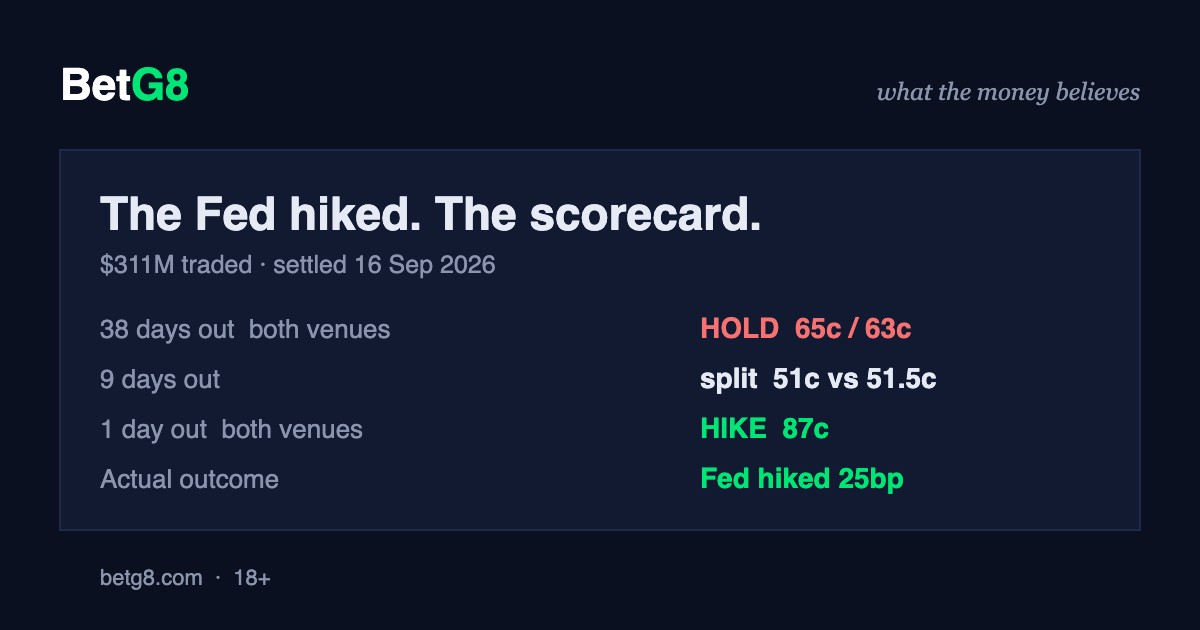
The Fed hiked. Here is the prediction market scorecard.
Five weeks out both venues favoured a hold. Nine days out they split. A day out both said 87c hike - and the Fed hiked. $311M traded, and the busiest contracts lost.
 September 17, 2026
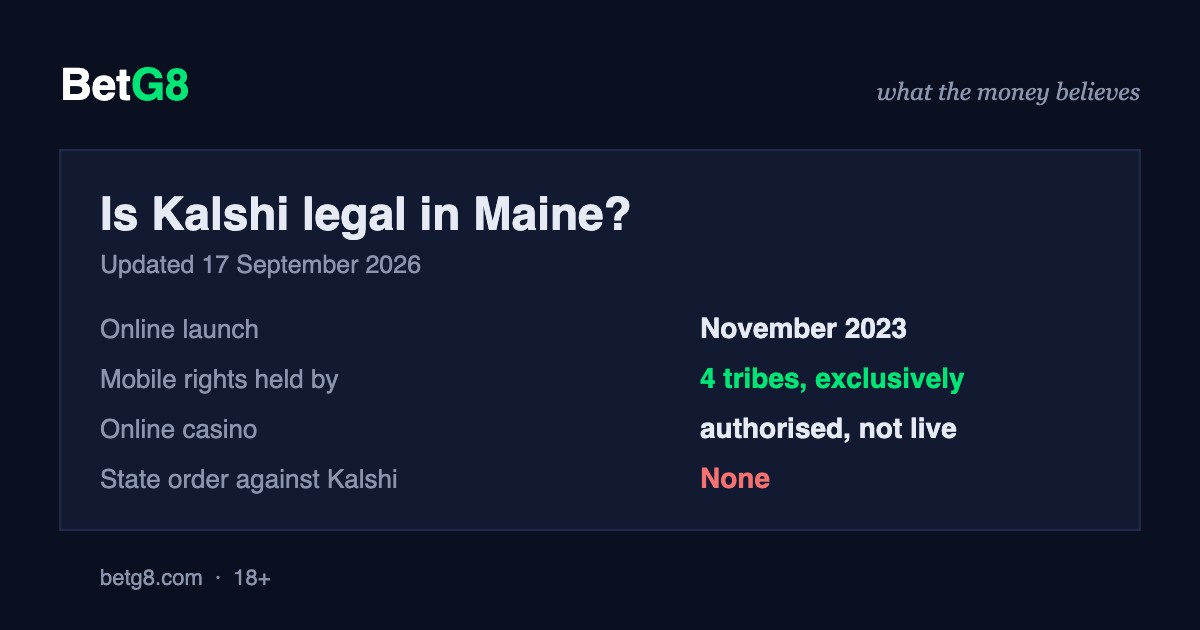
Is Kalshi legal in Maine?
Maine gave its four federally recognised tribes exclusive mobile rights as economic development policy. A federally regulated exchange routes around the whole arrangement.
 September 15, 2026
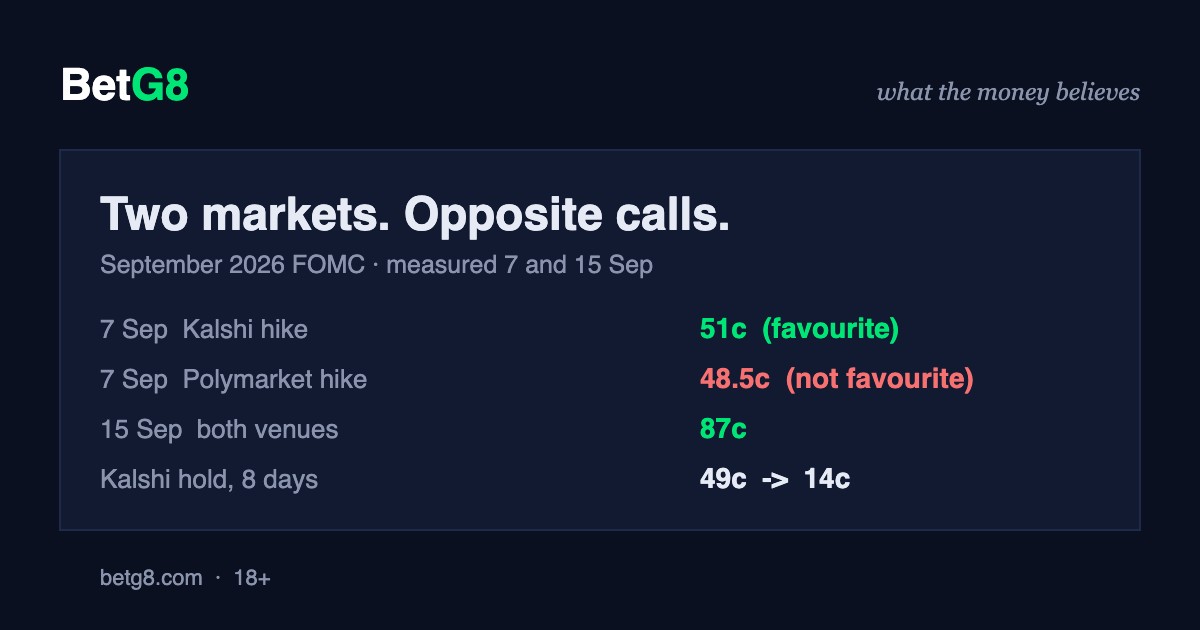
When two prediction markets disagree, which one is right?
On 7 September Kalshi and Polymarket named opposite favourites for the Fed decision. Eight days later both sit at 87c on the same outcome. We tracked the whole arc.
 September 15, 2026
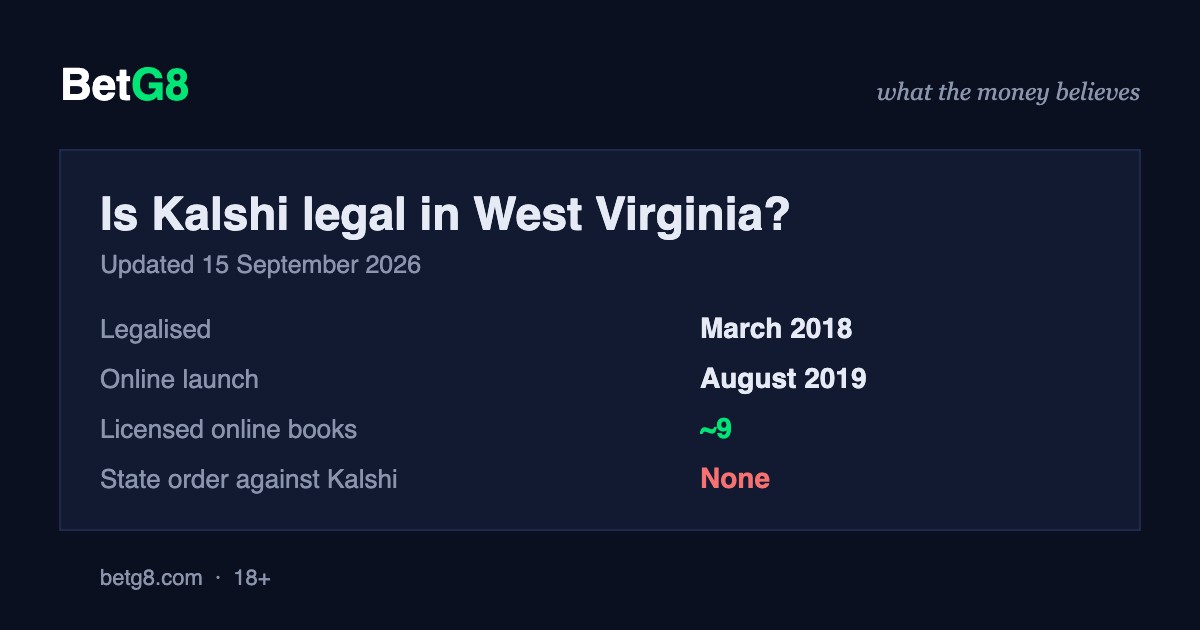
Is Kalshi legal in West Virginia?
The control case. West Virginia legalised in 2018, went online in 2019 and licensed nine books - and the exchanges still operate entirely outside all of it.
 September 11, 2026
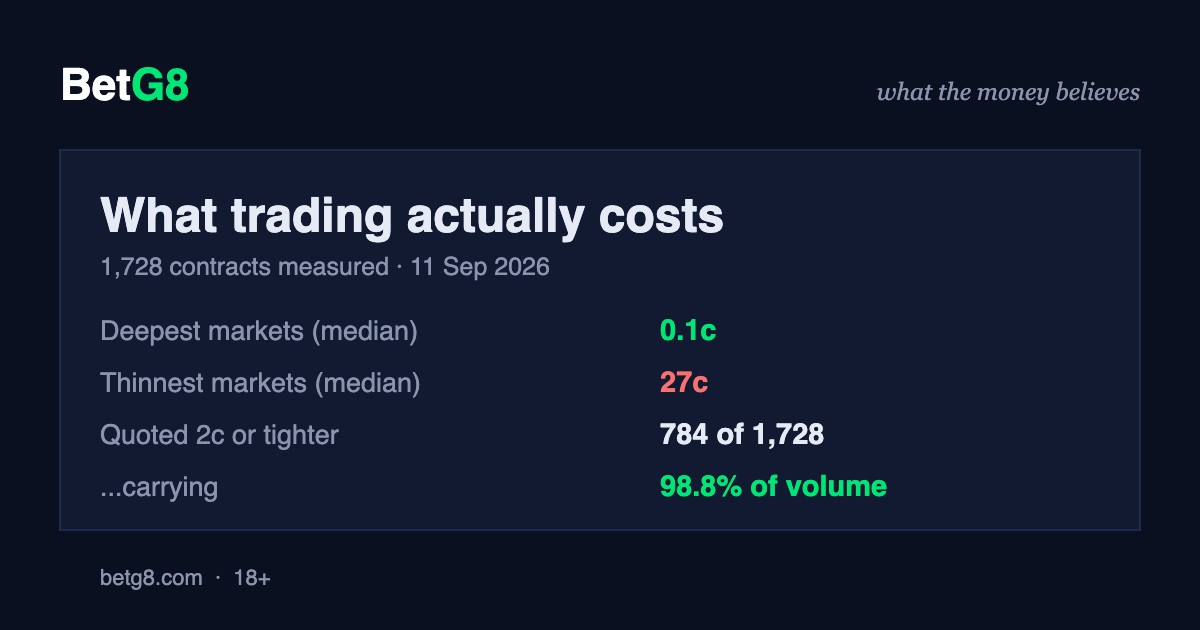
What does it actually cost to trade on a prediction market?
We measured 1,728 live contracts. Median 0.1c in the deepest markets, 27c in the thinnest. The 45% quoted under 2c carry 98.8% of the money.
 September 11, 2026
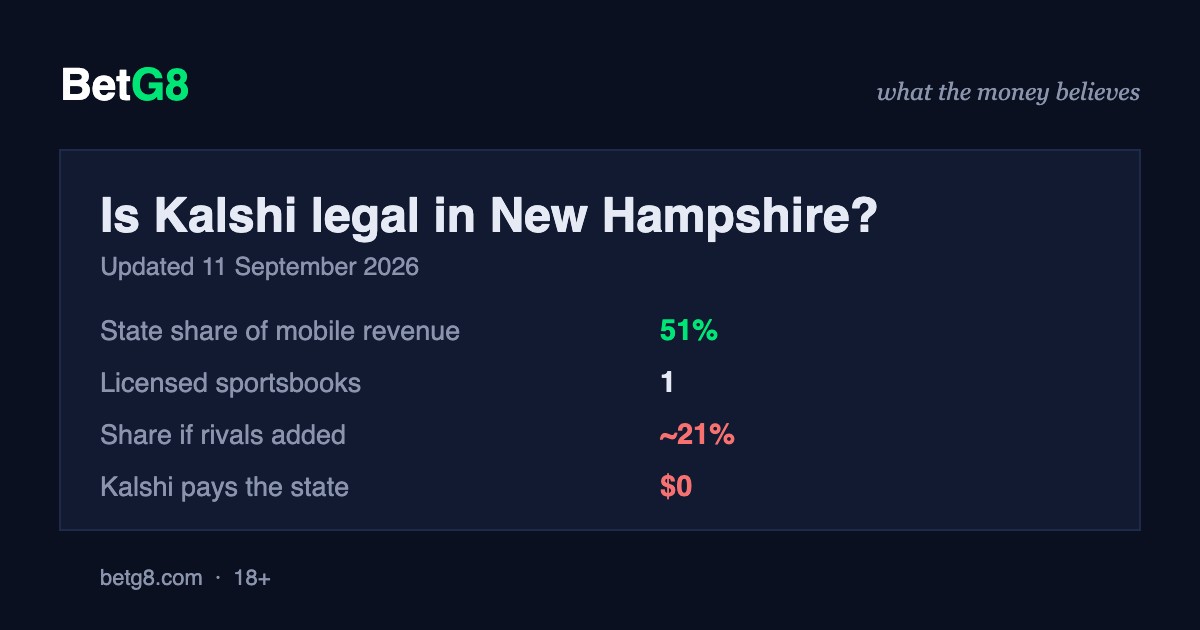
Is Kalshi legal in New Hampshire?
No state order restricts Kalshi here. But New Hampshire takes 51% of mobile betting revenue from one licensed operator - and that operator sells prediction markets everywhere except New Hampshire.
 September 9, 2026
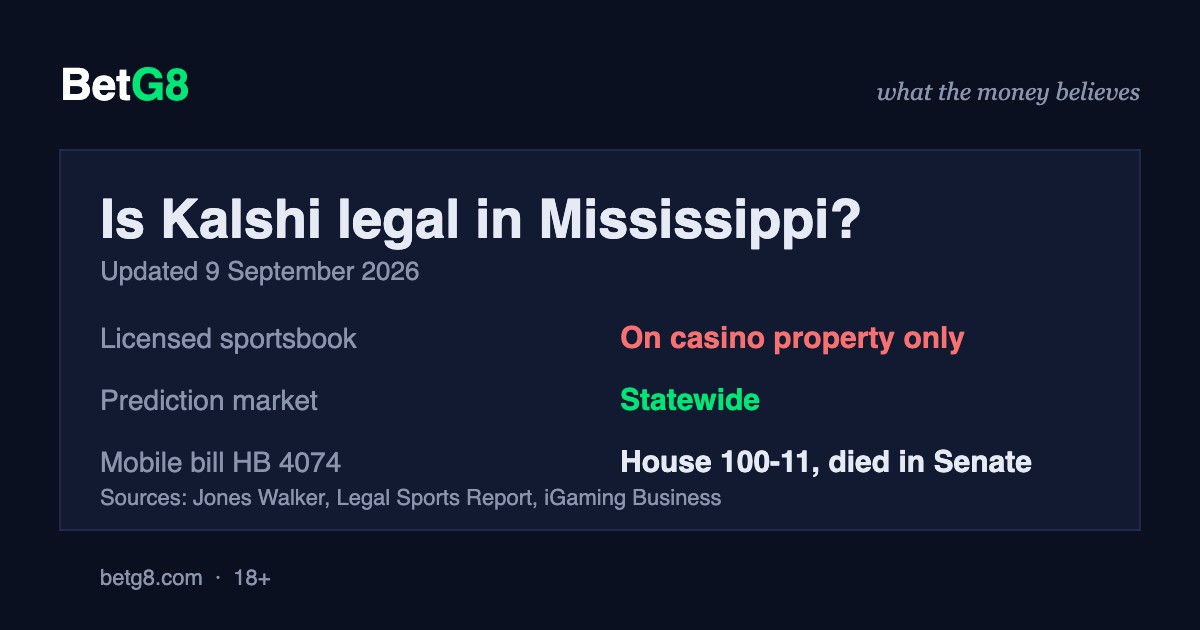
Is Kalshi legal in Mississippi?
No state order restricts Kalshi here. But a licensed Mississippi sports bet still requires being inside a casino - the mobile bill passed the House 100-11 and died in the Senate.
 September 8, 2026
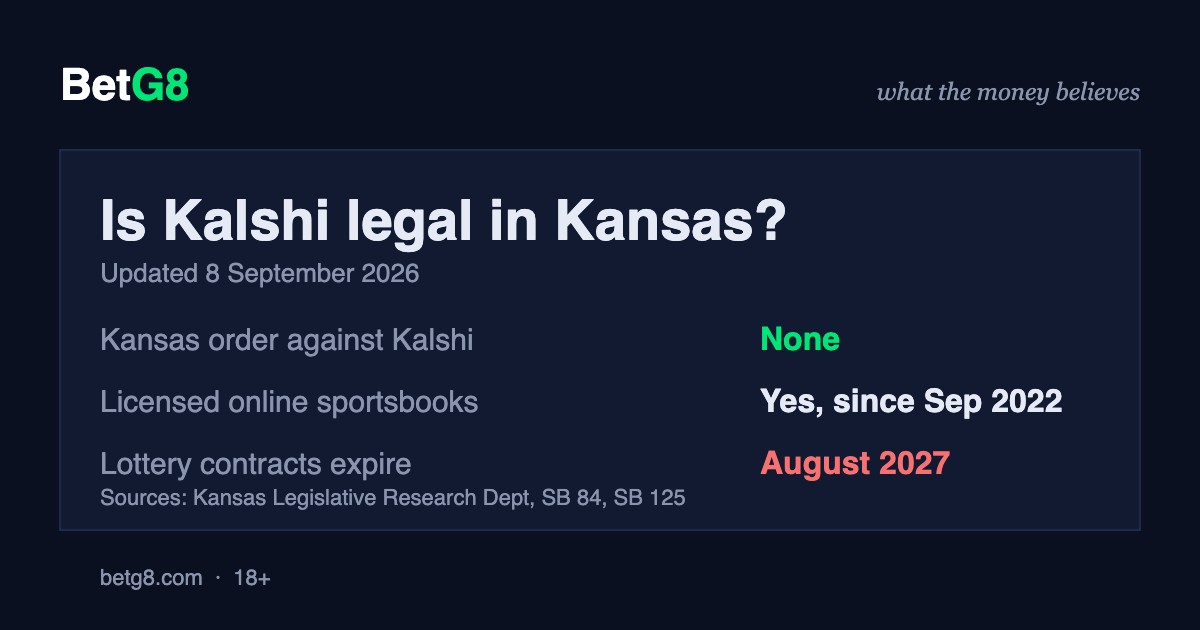
Is Kalshi legal in Kansas?
No Kansas order restricts Kalshi. But the contracts holding the licensed Kansas sportsbook market together expire in August 2027, and the legislature blocked renewal talks.
 September 7, 2026
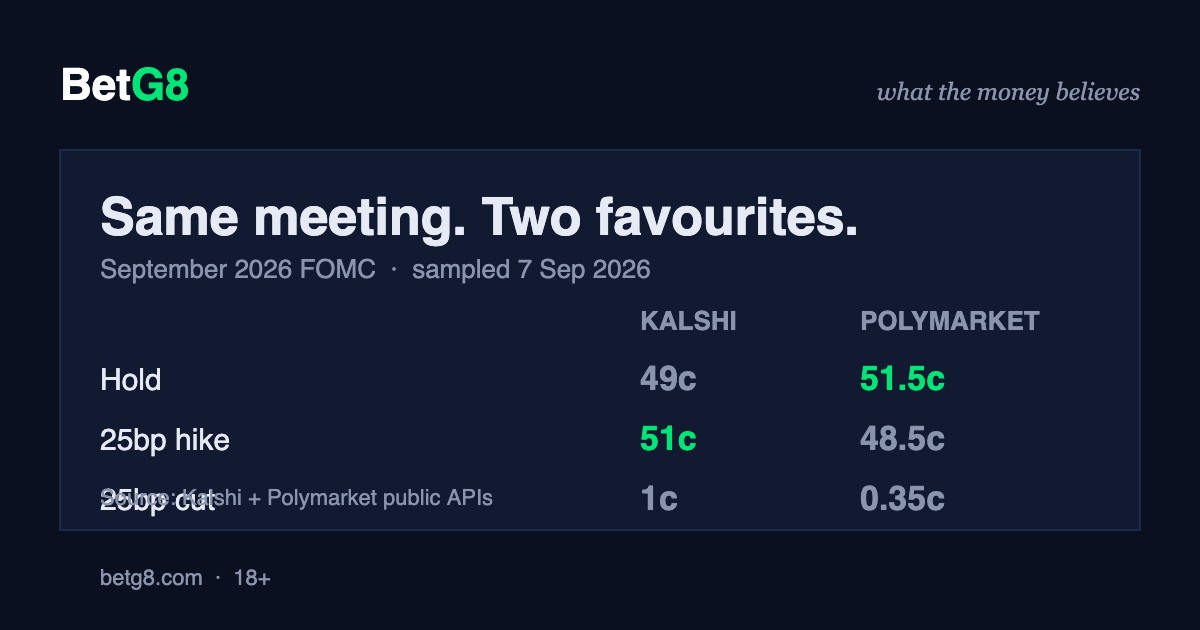
Can you trade Fed rate decisions on Kalshi and Polymarket?
Yes, and they are among the biggest markets on both venues. On 7 September the two exchanges named different favourites for the September FOMC meeting.
 Sep 7, 2026
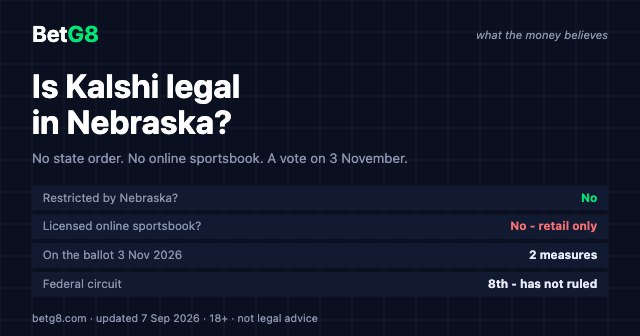
Is Kalshi legal in Nebraska?
No state order, no online sportsbook, and two ballot measures on 3 November. FanDuel and DraftKings put $3.5m each behind legalising - while running prediction markets there in the meantime.
 Sep 6, 2026
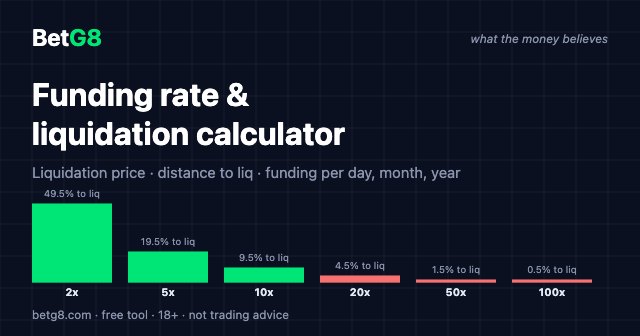
Funding rate & liquidation calculator: what a leveraged position really costs
Liquidation price, distance to liquidation, and what funding costs per day, month and year on notional and as a share of margin. Hyperliquid, Binance and Bybit intervals. Free tool.
 Sep 5, 2026
Will the Supreme Court take the Kalshi case?
New Jersey filed on 2 September. Kalshi’s response is due about 2 October, extendable. The market says 46¢ by year-end; an analyst says 90% eventually. Both can be right — one is about whether, the other about when.
 Sep 5, 2026
NFL Week 1: Kalshi vs Polymarket vs the books, logged before kickoff
Fourteen games, three prices each, one timestamp. Books de-vigged vs Kalshi vs Polymarket: max gap 2.2 points, median 1.0. Logged now, scored after the games.
 Sep 4, 2026
Kalshi's oil perpetual, explained
A future with no expiry date, funded three times a day, on a commodity that stops trading at weekends. What Kalshi is actually asking the CFTC for — and why oil is not bitcoin.
 Sep 2, 2026
Is Kalshi legal in Alabama?
No sportsbook, no lottery, no gaming regulator — and the Eleventh Circuit is the one circuit that has not ruled either way. Alabama is the emptiest map on the board.
 Sep 1, 2026
Is Kalshi legal in South Carolina?
No attorney general action at all. The only litigation is private, brought by a Delaware LLC under a loss-recovery statute South Carolina adopted in 1712. Kalshi still trades there.
 Sep 1, 2026
Is Kalshi legal in Arkansas?
Arkansas ruled prediction markets illegal in an attorney general opinion in October 2025, then sent no letter and filed no suit. It taxes three sportsbooks of its own while an untaxed rival runs openly.
 Sep 1, 2026
Is Kalshi legal in Idaho?
Idaho co-signed the 39-state brief that beat Kalshi in the Ninth Circuit on 28 August. Five days later the state has issued no letter, no suit, nothing. Kalshi still trades there.
 Sep 1, 2026
SCOTUS market: 29¢ to 55.5¢ in one hour
Hourly Polymarket data around the Ninth Circuit ruling. The December contract nearly doubled in sixty minutes. The October contract did not move at all. CSV included.
 Aug 31, 2026
Is Kalshi legal in Hawaii?
Hawaii bans every form of gambling and has no sportsbook. Kalshi and Polymarket still run here, and no Hawaii authority has ever written a letter.
 Aug 30, 2026
Is Kalshi legal in Alaska?
The Ninth Circuit ruling is binding precedent in Alaska. Alaska has no sportsbook, no lottery and no regulator built to enforce it.
 Aug 29, 2026
Ninth Circuit: what changes in each of its nine states
The ruling binds nine states. Two already have injunctions. Three have no legal sportsbook at all — and those are the ones nobody is writing about.
 Aug 26, 2026
Is Kalshi legal in Oklahoma? The state with no regulator to send the letter
No cease-and-desist, no licensed sportsbook, and a tribal exclusivity fight running through the Ninth Circuit instead.
 Aug 25, 2026
Is Kalshi legal in Rhode Island? The state that sued both — and got sued back
No injunction, no ruling, three live cases. And a state that takes a bigger cut of sports betting than any other.
 Aug 24, 2026
Is Kalshi legal in Utah? The first state to win a final judgment
No sportsbook, no lottery, no betting tax — and the first final federal judgment that state gambling law reaches Kalshi. What it does, and what it pointedly does not do.
 Aug 24, 2026
Is Kalshi legal in Louisiana? The loudest state without a lawsuit
The regulator says no licence, no market — and has sent the letters to prove it. What it has not done is sue. Kalshi operates untaxed while licensed books pay 21.5%.
 Aug 22, 2026
States are beating Kalshi 19–4. The coverage says the opposite.
Nineteen of 23 injunction decisions have gone to the states. Why the reporting reads the other way — and a correction to our own newsletter.
 Aug 22, 2026
Is Kalshi legal in Virginia? The state that legislated everything else
Virginia wrote rules for online casinos, skill games and DFS in 2026. Event contracts were in none of them — and the Fourth Circuit is about to rule above the state anyway.
 Aug 21, 2026
Is Kalshi legal in North Carolina? The first state to write CFTC authority into law
Prediction Markets Aug 20, 2026
Is Kalshi legal in Indiana? The state whose regulator says it is not the regulator
Prediction Markets Aug 19, 2026
Is Kalshi legal in Oregon? The only state where the gap is a rule, not a lawsuit
Prediction Markets Aug 18, 2026
Do Kalshi’s geofences actually work?
Prediction Markets Aug 17, 2026
Is Kalshi legal in Missouri?
Prediction Markets Aug 16, 2026
Whale board: the top BTC long changed hands
Prediction Markets Updated Sep 6, 2026
Prediction market change log: every dated rule change
Prediction Markets Aug 14, 2026
Is Kalshi legal in Tennessee? The case that could split the circuits
Prediction Markets Aug 13, 2026
Is Kalshi legal in your state? The 50-state tracker
Prediction Markets Aug 13, 2026
Is Kalshi legal in Iowa?
Prediction Markets Aug 13, 2026
Is Kalshi legal in Montana?
Prediction Markets Aug 13, 2026
Is Kalshi legal in Colorado?
Prediction Markets Aug 12, 2026
Is Kalshi legal in Texas? The state that studied instead of sued
Prediction Markets Aug 12, 2026
Is Kalshi legal in Florida? The compact question nobody has litigated
Prediction Markets Aug 12, 2026
Is Kalshi legal in Pennsylvania? The regulator objects, the legislature negotiates
Prediction Markets Aug 12, 2026
Could Congress ban sports prediction markets? The bills, the hearing and the realistic odds
Prediction Markets Aug 12, 2026
Is Kalshi legal in Illinois? Sports contracts are blocked, and a tax is waiting
Prediction Markets Aug 12, 2026
Is Kalshi legal in Connecticut? The first cease-and-desist, and what happened next
Prediction Markets Aug 12, 2026
Is Kalshi legal in Maryland? The case Kalshi lost, and the split it created
Prediction Markets Aug 12, 2026
Is Kalshi legal in Georgia? The only sports market in the state
Prediction Markets Aug 11, 2026
Is Kalshi legal in Wisconsin? The CFTC just lost round one
Prediction Markets Aug 11, 2026
Is Kalshi legal in California? The tribes, the Ninth Circuit and what happens next
Prediction Markets Aug 11, 2026
Is Kalshi legal in Arizona? The criminal case that got thrown out
Prediction Markets Aug 11, 2026
Is Kalshi legal in Minnesota? The ban that never started
Prediction Markets Aug 10, 2026
Is Kalshi legal in Michigan? The August 12 deadline that decides it
Prediction Markets Aug 10, 2026
Is Kalshi legal in Kentucky? The Coleman lawsuit, explained
Prediction Markets Aug 10, 2026
Is Kalshi legal in Ohio? The $5 million fine fight, explained
Prediction Markets Aug 10, 2026
Is Kalshi legal in New York? The $36 billion James lawsuit, explained
Prediction Markets Aug 10, 2026
Is Kalshi legal in New Jersey?
Prediction Markets Aug 10, 2026
Is Kalshi legal in Washington? The injunction is live — and the geofence lands August 26
Prediction Markets Aug 10, 2026
How do election prediction markets work?
Prediction Markets Aug 10, 2026
Sportsbook vs prediction market: which one actually gives you a better price?
Prediction Markets Aug 8, 2026
Kalshi vs Polymarket fees compared: what a trade actually costs in 2026
Prediction Markets Aug 7, 2026
Is Kalshi legal in New Mexico? Two lawsuits, no injunction — yet
Prediction Markets Aug 6, 2026
Is Kalshi legal in Massachusetts? The Supreme Judicial Court case, explained
Prediction Markets Aug 4, 2026