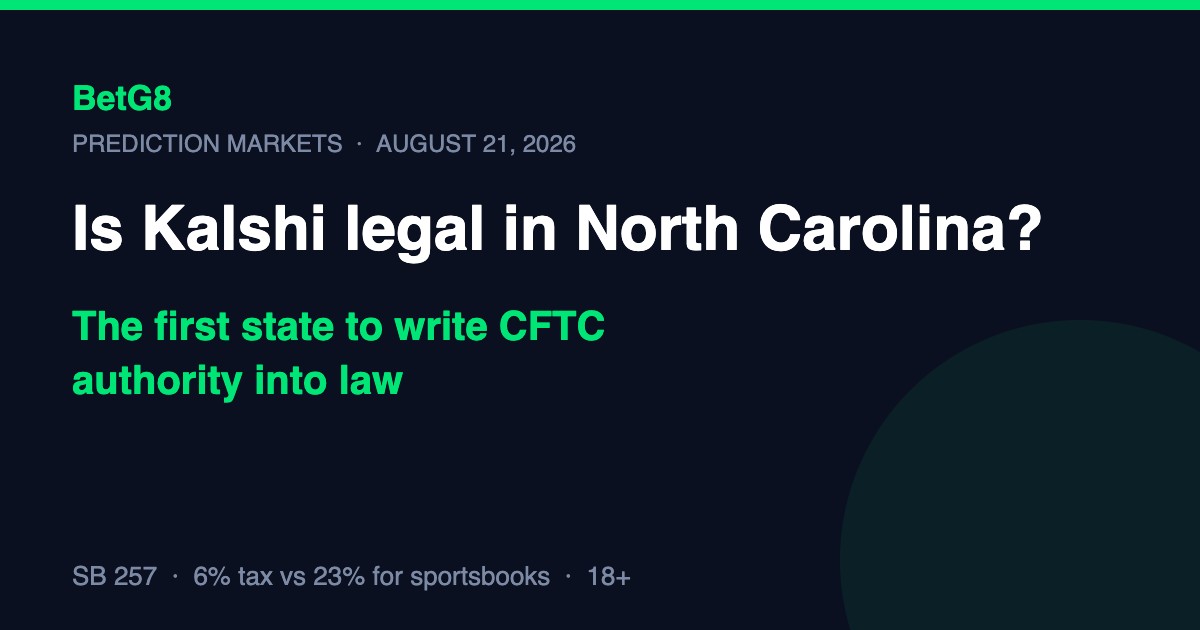
Is Kalshi legal in North Carolina? The first state to write CFTC authority into law
Every other state in this fight is arguing about whether the federal government owns prediction markets. North Carolina wrote the answer into its budget and moved on.
The timeline
| Date | What happened |
|---|---|
| Nov 4, 2020 | Kalshi receives CFTC designated-contract-market status, the federal licence that underpins every argument in this dispute. |
| Jun 14, 2023 | North Carolina legalises mobile sports wagering through HB 347, naming the State Lottery Commission as regulator. |
| Mar 11, 2024 | Eight licensed mobile sportsbooks go live in North Carolina at an 18% tax on gross wagering revenue. |
| Jan–Jun 2026 | A wave of states — Nevada, New Jersey, Maryland, Arizona, Montana and others — issue cease-and-desist orders or sue Kalshi. North Carolina issues nothing. |
| Jul 7, 2026 | Governor Josh Stein signs Senate Bill 257. North Carolina becomes the first state to recognise in statute that the Commodity Exchange Act establishes exclusive federal regulatory authority for the CFTC over prediction markets. The same bill raises the sports wagering tax to 23% and sets a 6% tax on prediction market operators. |
| Jul 31, 2026 | New York sues Kalshi, calling its markets an illegal gambling operation. North Carolina's posture does not change. |
| Aug 11, 2026 | The CFTC invokes emergency powers to order Kalshi to keep operating in New York despite state action. |
| Aug 13, 2026 | Baltimore files consumer protection actions against both Kalshi and Polymarket. Still no North Carolina action. |
| Jan 1, 2027 | The 6% North Carolina prediction market tax takes effect. |
What SB 257 actually does — and what it does not
The provision is short, and most of its significance is in what it leaves out. What it does: it recognises the Commodity Exchange Act as establishing exclusive federal regulatory authority for the CFTC over prediction markets, and it levies a 6% tax on operators' net trading fee revenue attributable to North Carolina residents beginning January 1, 2027.
What it does not do is the longer list. It does not define prediction markets as gambling. It does not require a licence or a registration. It does not create a state enforcement mechanism, and it does not hand jurisdiction to the North Carolina State Lottery Commission, which regulates the state's eight licensed mobile sportsbooks. Nothing in it gives a North Carolina agency a lever to pull if it later changes its mind.
That distinction matters more than the tax rate. A licensing regime is an assertion of authority; a revenue provision is not. North Carolina collects money from a product while explicitly disclaiming the power to regulate it — which is exactly the combination roughly a dozen other states are spending litigation budgets trying to avoid.

The 6% and the 23%
The same budget bill raised North Carolina's sports wagering tax from 18% to 23% and set the prediction market rate at 6%. Read carelessly, that looks like a four-to-one advantage for Kalshi. Read carefully, it is not a clean comparison at all.
Sportsbooks pay 23% on gross wagering revenue — the hold, meaning everything staked minus everything paid out. Prediction markets pay 6% on net trading fees, which is only the commission the venue charges to match two counterparties. The bases are different products of different sizes, so the headline spread overstates the gap. The direction, though, is not in dispute: North Carolina has legislated a lower effective cost for the CFTC-regulated venue than for the state-licensed one, inside the same borders, on overlapping events.
This is the first US jurisdiction where that coexistence is a written policy choice rather than the byproduct of an unresolved lawsuit. It is also the first place where a licensed sportsbook can point at a statute and say a competitor is being taxed less for selling exposure to the same game. Whether that argument gets traction in the 2027 short session is one of the more concrete things to watch in this space.
Where North Carolina sits on the national map
| Posture | States | North Carolina? |
|---|---|---|
| Court-ordered restriction or active suit | Nevada, New Jersey, New York, Maryland, Arizona, Montana, Washington | No |
| Cease-and-desist issued, enforcement paused by court | Tennessee, Ohio, Michigan, Massachusetts, New Mexico | No |
| No formal state action on record | Virginia, Missouri, Indiana, Oregon, Texas, Florida and most remaining states | No |
| Federal authority recognised in enacted statute | North Carolina | Yes — only state |
Why this matters outside North Carolina
Kalshi now has something it did not have in January: a state legislature on the record. In every preemption brief filed through the first half of 2026, opposing counsel could say that no state had affirmed exclusive federal authority over these contracts. That sentence is no longer accurate, and it will be cited.
The second effect is a template. States watching the litigation have had two options — sue and hope, or do nothing and collect nothing. North Carolina invented a third: take the revenue, skip the fight. For a state with a thin appetite for federal litigation, 6% of something is a better trade than 100% of a court case. Expect the model to be copied before it is challenged.
The caveat is structural. This arrived as a provision inside an annual budget, not as standalone gaming legislation, and budget provisions are revisited every cycle. A statutory recognition that took one line to enact takes one line to remove.
What would change this
Three things, in rough order of likelihood.
One: the next budget narrows it. North Carolina's licensed operators now pay nearly four times the headline rate of an unlicensed competitor. That is a live lobbying position, and the vehicle that created the provision is the same vehicle that can amend it.
Two: a federal appellate court rules against preemption. North Carolina sits in the Fourth Circuit. A state statute recognising federal authority does not survive a federal holding that the authority is not exclusive — the recognition would simply describe something that no longer exists. With district courts split between the New York and Tennessee outcomes, this is the question heading upward.
Three: the CFTC narrows the product itself. If the Commission restricts sports event contracts at the federal level, North Carolina's 6% would apply to a substantially smaller business, and the state's bet on federal jurisdiction would have been correct but worthless.
Until one of those lands, the position holds: available, unlicensed, untaxed until January, and legally the most settled state in the country.
FAQ
- Is Kalshi legal in North Carolina?
- Yes, and North Carolina is the only state that says so in statute. Senate Bill 257, signed by Governor Josh Stein on July 7, 2026, recognizes that the Commodity Exchange Act establishes exclusive federal regulatory authority for the CFTC over prediction markets. Kalshi and Polymarket US both hold CFTC designated-contract-market status and operate in North Carolina with no state enforcement action on record.
- Did North Carolina ban prediction markets?
- No. The opposite. North Carolina declined to treat prediction markets as gambling and instead acknowledged federal jurisdiction over them. More than a dozen other states have taken the reverse position through cease-and-desist orders or lawsuits.
- Do Kalshi or Polymarket need a North Carolina license?
- No. SB 257 imposes no licensing or registration requirement, creates no parallel state enforcement mechanism, and does not place prediction markets under the North Carolina State Lottery Commission. The tax is a revenue provision, not a licensing regime.
- What is the 6% North Carolina prediction market tax?
- SB 257 imposes a 6% tax on prediction market operators' net trading fee revenue attributable to North Carolina residents, effective January 1, 2027. Licensed mobile sportsbooks in the state pay 23% on gross wagering revenue under the same budget bill.
- Does the New York ruling against Kalshi affect North Carolina?
- No. The New York decision is a New York state matter and binds conduct there. North Carolina sits in the Fourth Circuit and has its own statute pointing the other way. A federal appellate or Supreme Court ruling on preemption is what would reach North Carolina.
- Is North Carolina the only state to recognize CFTC authority in law?
- As of August 2026, yes. Several states have taken no formal action, which is silence rather than endorsement. North Carolina is the first and so far only state to put the recognition into enacted statute.
Sources
- The Block: North Carolina passes bill recognizing CFTC preemption over prediction markets
- Decrypt: North Carolina bill recognizes CFTC's federal regulatory authority
- FinanceFeeds: North Carolina recognizes CFTC authority over prediction markets
- CNBC: New York sues Kalshi over prediction markets
- CoinDesk: CFTC orders Kalshi to continue operating in New York