Is Kalshi legal in Kansas?
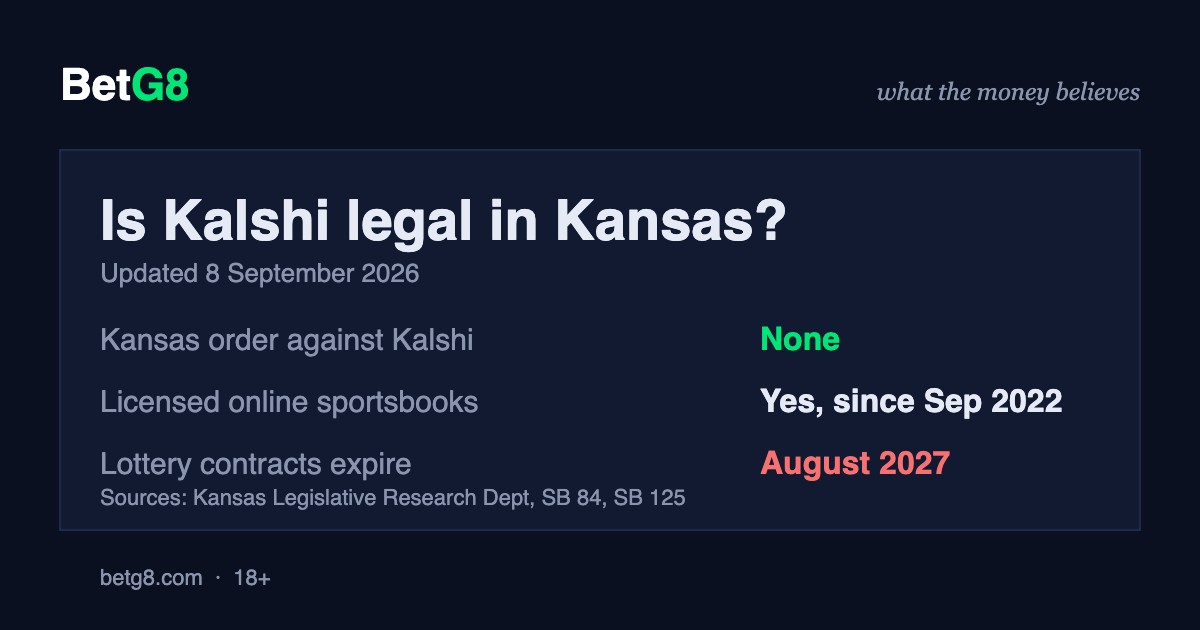
Kansas at a glance
| Question | Position as of 8 September 2026 |
|---|---|
| Does Kalshi accept Kansas users? | Yes, with no state-specific restriction reported |
| Has Kansas issued a cease and desist? | No publicly reported order |
| Is Kansas in the Kalshi litigation? | No |
| Licensed online sports betting? | Yes, live since 1 September 2022 |
| Regulators | Kansas Lottery and Kansas Racing and Gaming Commission |
| Maximum online sportsbooks | Twelve - four casino managers, three skins each |
| Key date ahead | August 2027, when Lottery manager contracts expire |

How Kansas got here
12 May 2022. Governor Laura Kelly signs Senate Bill 84, authorising sports wagering at the four state-owned commercial casinos and through their online partners statewide.
1 September 2022. Licensed betting goes live. The market is administered jointly by the Kansas Lottery, which holds the contracts, and the Kansas Racing and Gaming Commission, which handles licensing and compliance.
2025 session. The legislature passes SB 125, the appropriations bill. A proviso inside it bars the Lottery from spending money to negotiate, enter into, extend or renew any sports wagering management contract with a lottery gaming facility manager for fiscal years 2025 and 2026.
August 2027. The existing Lottery contracts with the casino managers expire. Nothing currently authorises the Lottery to have replaced them.
Throughout. No Kansas action against Kalshi or Polymarket is publicly on record.
Where the national fight stands
| Circuit | Case | Result |
|---|---|---|
| Third | New Jersey | Ruled for Kalshi, April 2026 |
| Ninth | Nevada | Ruled for the state, August 2026 |
| Second | Connecticut | Kalshi appeal pending |
States with a reported cease and desist include Nevada, New Jersey, Maryland, Montana, Illinois, Ohio and Arizona. New York and Connecticut have filed suit. Kansas appears on none of those lists. We keep the dated record of every action in the prediction market change log and the current state map in the Kalshi legality tracker.
Why Kansas has stayed quiet
The states that moved against Kalshi first were mostly states whose regulators had a licensed market to defend and a clear complaint from licensees paying for the privilege. Kansas has that market, but it also has an unusual amount of its own regulatory attention already committed. The Lottery is running a sports wagering programme whose legal scaffolding has a fixed end date and no authorised path to renewal.
That matters for anyone reading this page as a forecast. A state that has not yet acted is not a state that has decided not to act. Kansas has taken no public position on whether a sports event contract is a wager under Kansas law, and silence is not a ruling. If the Second Circuit sides with Connecticut, the calculation changes for every state that has been watching rather than filing.
The reverse is also true. If the Third Circuit position spreads, a Kansas regulator has less reason to open a fight it might lose while its own licensing framework is unsettled.
The 2027 cliff, and why it belongs on this page
Most state pages about prediction markets treat the licensed sportsbook market as a fixed backdrop. In Kansas it is not fixed. The contracts between the Lottery and the four casino managers run out in August 2027, and the 2025 appropriations proviso prevented the Lottery from even negotiating a replacement during the two fiscal years leading up to that.
Whatever the legislature does next, there is a window in which Kansas has to rebuild the commercial arrangements underneath its regulated market. Kalshi has no equivalent exposure in Kansas, because it holds no Kansas contract and no Kansas licence. It argues it does not need one.
That asymmetry is the whole argument in miniature. The licensed operators are paying for access that has an expiry date printed on it. The exchange is offering something that looks similar to a customer, on the basis that it is a federally regulated financial instrument rather than a wager, and its access has no state renewal date at all. For a comparison of what the two products actually cost the user, see sportsbooks versus prediction markets.
What this means in practice
A Kansas resident today can open a Kalshi account and can also use a licensed Kansas sportsbook. Neither of those facts is a legal opinion, and the first one could change on any business day if a Kansas regulator decides to act, as seven other states have. Kalshi has withdrawn or geofenced markets in states after orders were issued, so access is not a guarantee of continuity.
This page describes the regulatory position and the market structure. It is not legal advice and it is not a recommendation to trade or wager anything.
What changed since September
No new Kansas action as of November 4, 2026. The Racing and Gaming Commission has not written to Kalshi, the attorney general has not sued, and the 2027 Lottery-contract cliff described above is unchanged. The movement has been in the court that binds Kansas and in the federal rules. On September 8 the Tenth Circuit, the appeals court for Kansas as well as Utah, refused to block Utah’s enforcement while Kalshi appeals its August loss there (Yogonet); the merits appeal is briefed but has no argument date, and its outcome will be the first appellate word on sports contracts in Kansas’s circuit. Utah then escalated: the attorney general sued Kalshi and Susquehanna in state court on October 20, the CFTC sued Utah on October 26 in its tenth suit against a state (RG.org), Utah filed criminal charges against Kalshi and its two founders on October 28 (Deseret News), and by November 2 DraftKings, FanDuel, Robinhood and Fanatics had pulled their event contracts from Utah (FOX 13). None of that touches Kansas directly, but a Kansas regulator now has a next-door template for every level of escalation.
Nationally, the Sixth Circuit held on September 25 that Kalshi had not shown its sports contracts are swaps and that state gambling law is not preempted either way (Courthouse News), and on October 9 the CFTC excluded licensed casino and sportsbook bets from the swap definition while proposing to write event contracts in (CFTC). New Jersey’s Supreme Court petition in No. 26-299 drew a 39-state amicus brief on October 7 and the NFL’s brief on October 8; Kalshi’s response is due November 9. Kansas’s own Senate race, meanwhile, was one of the most traded state contests on the exchanges: Democrat Adam Hamilton went from 39 cents on Kalshi on October 26 to 63 cents on November 2 and won on November 3, as recorded in our midterm scorecard. Every dated development is in the change log.
Frequently asked questions
Is Kalshi legal in Kansas?
Kalshi operates in Kansas and no Kansas regulator has issued a public cease and desist order against it. Kansas is not among the states that have ordered Kalshi to stop offering sports event contracts, and it is not party to the litigation now running through the Second, Third and Ninth Circuits. That is the practical position rather than a formal ruling that the contracts are lawful under Kansas law.
Is sports betting legal in Kansas?
Yes. Governor Laura Kelly signed Senate Bill 84 on 12 May 2022 and licensed betting launched on 1 September 2022. The market is run jointly by the Kansas Lottery and the Kansas Racing and Gaming Commission, through the four state-owned commercial casinos and their online partners.
How many online sportsbooks can Kansas have?
Each of the four casino managers may partner with up to three mobile operators, which caps the market at twelve online sportsbooks. Major national operators including FanDuel, DraftKings, BetMGM and bet365 are live in the state.
What happens to Kansas sports betting in 2027?
The contracts between the Kansas Lottery and the casino managers expire in August 2027. A proviso in SB 125, the appropriations bill passed by the 2025 legislature, barred the Lottery from spending money to negotiate, enter, extend or renew those contracts during fiscal years 2025 and 2026.
Has Kansas sued Kalshi?
No. As of 8 September 2026 there is no publicly reported Kansas lawsuit or cease and desist against Kalshi. States that have taken formal action include Nevada, New Jersey, Maryland, Montana, Illinois, Ohio and Arizona, with separate suits filed by New York and Connecticut.
Can you use Polymarket in Kansas?
Polymarket has no Kansas-specific restriction either. Like Kalshi it operates under a federal framework argument rather than a Kansas licence, and Kansas has not tested that argument in court.
Sources
- Kansas Legislative Research Department, Briefing Book 2026: Sports Wagering, for the SB 125 proviso and the August 2027 contract expiry.
- Legal Sports Report, Kansas sports betting legislation updates.
- RotoWire, Kansas sports betting guide, for the live operator list.
- The Hill, Ninth Circuit ruling on state regulation of prediction markets.
- Connecticut Attorney General, Connecticut sues Kalshi, 26 August 2026.
18+ only. Prediction market contracts and sports wagering carry real financial risk. This page is analysis, not legal, financial or betting advice. If gambling stops being fun, help is available at 1-800-GAMBLER.