When two prediction markets disagree, which one is right?
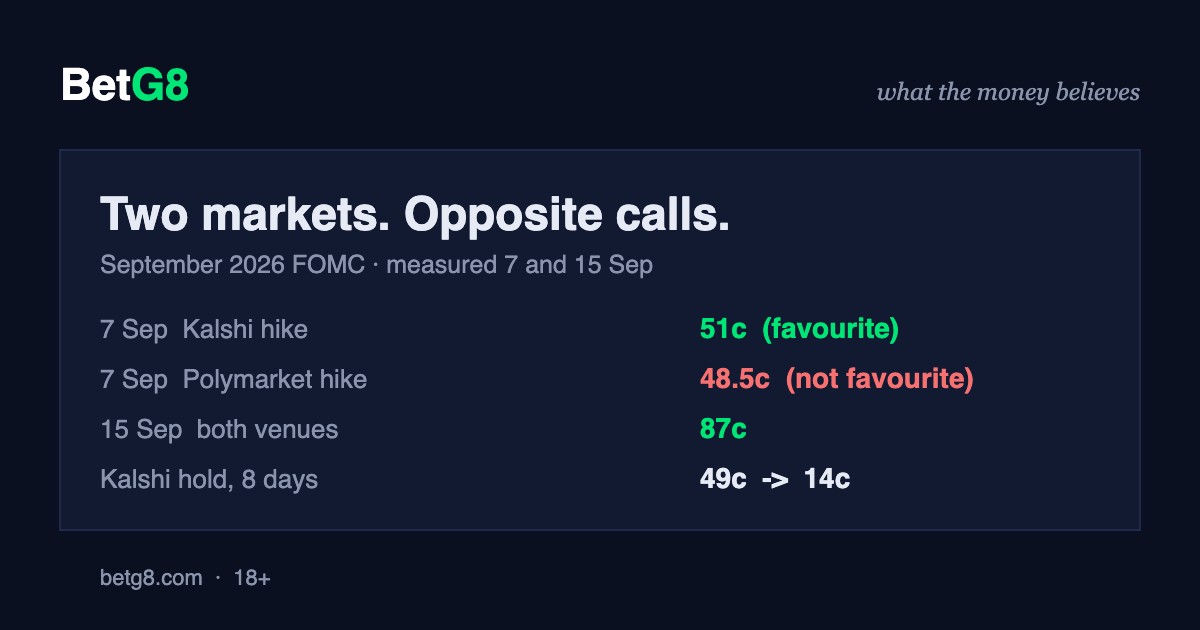
The whole arc, in four measurements
| Date | Kalshi hold | Kalshi 25bp hike | Polymarket hold | Polymarket 25bp hike |
|---|---|---|---|---|
| 9 August | 65c | - | 63c | - |
| 7 September | 49c | 51c | 51.5c | 48.5c |
| 15 September | 14c | 87c | 13c | 87c |
The 9 August figures are quoted from Prediction News, which reported them alongside a CME FedWatch reading of 55.6 percent at the time. The 7 and 15 September figures were measured by us directly from each venue public API. On 15 September the two venues were quoting the same outcome within a single cent of each other.
Read left to right, the story is a market changing its mind completely. A hold was a 65 percent proposition in early August after a weak July jobs report. By early September, following a payrolls print that ran the other way, it was a coin flip. By the eve of the meeting, a hike was an 87 cent contract and the cut side had collapsed to a penny.

What the 7 September disagreement actually looked like
The interesting moment was the middle row. The two venues were not merely a few cents apart on a number; they disagreed about which outcome was the favourite. Kalshi had the hike in front by two cents, Polymarket had the hold in front by three. Anyone taking a screenshot of one venue and calling it the market consensus would have described the opposite of what the other venue was saying.
That gap was not caused by thin books. Polymarket had recorded about 100.7 million dollars of volume on the September event and Kalshi about 36 million across its five contracts. These were among the largest macro markets either venue ran. Two deep, liquid order books simply held different views for a while.
We wrote that disagreement up on the day, without knowing how it would resolve: can you trade Fed rate decisions on Kalshi and Polymarket. This page is the follow-up.
So was Kalshi right?
Directionally, on this event, yes. Kalshi named the hike as favourite on 7 September and the market converged toward the hike. Polymarket named the hold and the market moved away from it.
It would be dishonest to make more of that than it deserves. This is one event. A two or three cent edge resolving the right way is exactly what chance produces most of the time, and a single correct call tells you almost nothing about which venue prices better in general. Anybody who tells you otherwise is selling something.
What it does establish is that the question is answerable. The disagreement was public and timestamped before the outcome was known, and the resolution is public and timestamped now. Do this across fifty events and you would have evidence rather than an anecdote. That is the exercise we intend to keep running.
The money followed the conviction
| 7 September | 15 September | |
|---|---|---|
| Polymarket event volume | $100.7M | $172.8M |
| Polymarket resting liquidity | $6.1M | $12.7M |
| Kalshi, hold contract volume | $14.8M | $37.7M |
| Kalshi, hike contract volume | $6.9M | $15.1M |
Volume roughly doubled on both venues over the eight days, and resting liquidity on Polymarket more than doubled. Conviction and participation rose together, which is the ordinary pattern as an event approaches settlement and the remaining uncertainty gets cheaper to price.
One detail from the earlier snapshot is worth revisiting. On 7 September the Kalshi 25 basis point cut contract traded at 1c while carrying about 6.3 million dollars of open interest. On 15 September it still trades at 1c, and open interest has grown to about 9.0 million. That is a large and growing amount of money parked in an outcome the same order book has priced at a penny for over a week.
Why nobody simply closed the gap
A price difference on identical contracts looks like free money and usually is not. To act on a three cent cross-venue gap you need funded accounts on both venues, you pay fees on both legs, your capital is locked until settlement, and you are carrying the risk that the two contracts are not quite identical in their resolution wording.
Kalshi settles in dollars under CFTC rules; Polymarket settles in stablecoin on a public blockchain. Moving collateral between those two worlds is neither instant nor free. A gap has to be considerably wider than three cents before it survives the round trip, which is exactly why gaps of this size can persist for days in plain sight.
For the cost side of that calculation, see our measurement of what it actually costs to trade on a prediction market, and the fee comparison between the two venues.
How we measured this
The 7 and 15 September figures were read directly from each venue public API on those dates: the Kalshi events endpoint for KXFEDDECISION-26SEP with nested markets, and the Polymarket Gamma events endpoint for the September Fed decision event. Prices are venue last traded prices. Volume, liquidity and open interest are the venue reported fields in US dollars. Both venues were sampled within the same minute on each date so the two sides are contemporaneous.
The 9 August figures are quoted from Prediction News and were not measured by us; they are labelled as such in the data file. This page was written before the Federal Reserve announced its decision, so it reports what the markets believed, not what happened.
Both captures are published together as a CSV: download the 7 September capture and the 15 September follow-up. Reuse is fine with or without credit.
Frequently asked questions
What happens when two prediction markets show different prices for the same event?
Nothing forces them to agree. They are separate order books with separate participants and collateral, and moving money between them costs time and fees. A three point gap on the modal outcome persisted on 7 September 2026 and had closed to roughly one point by 15 September.
Which venue was right about the September 2026 Fed decision?
Kalshi. On 7 September it priced a 25bp hike at 51c against a 49c hold, while Polymarket had the hold in front at 51.5c. By 15 September both venues priced the hike at 87c.
Does one correct call mean Kalshi is more accurate?
No. This is a single event, which is an anecdote rather than evidence. A three point edge resolving the right way is well within what chance produces. The useful part is the method, not the verdict.
How much did the price move?
On 7 September the Kalshi hold was 49c and the hike 51c. By 15 September the hold was 14c and the hike 87c. On 9 August the same hold contract had been quoted at 65c.
Can you arbitrage a gap between two prediction markets?
In principle yes, in practice rarely. You need funded accounts on both venues, you pay fees on both legs, capital is locked until settlement, and the contracts must be genuinely identical in their resolution terms.
Where can I check these numbers?
Both venues publish live prices through public APIs, and the underlying figures are published here as downloadable CSVs with capture timestamps.
Sources
- Kalshi public API, event KXFEDDECISION-26SEP with nested markets, sampled 7 and 15 September 2026.
- Polymarket Gamma API, event slug fed-decision-in-september-762, sampled 7 and 15 September 2026.
- Prediction News, Kalshi and Polymarket converge on September Fed hold odds after jobs miss, 5 August 2026, for the 9 August prices.
- BetG8, can you trade Fed rate decisions on Kalshi and Polymarket, 7 September 2026.
18+ only. Prediction market contracts carry real financial risk. This page reports measured prices on specific dates; it is not financial, legal or betting advice, and it is not a recommendation to take any position. If gambling stops being fun, help is available at 1-800-GAMBLER.