Can you trade Fed rate decisions on Kalshi and Polymarket?
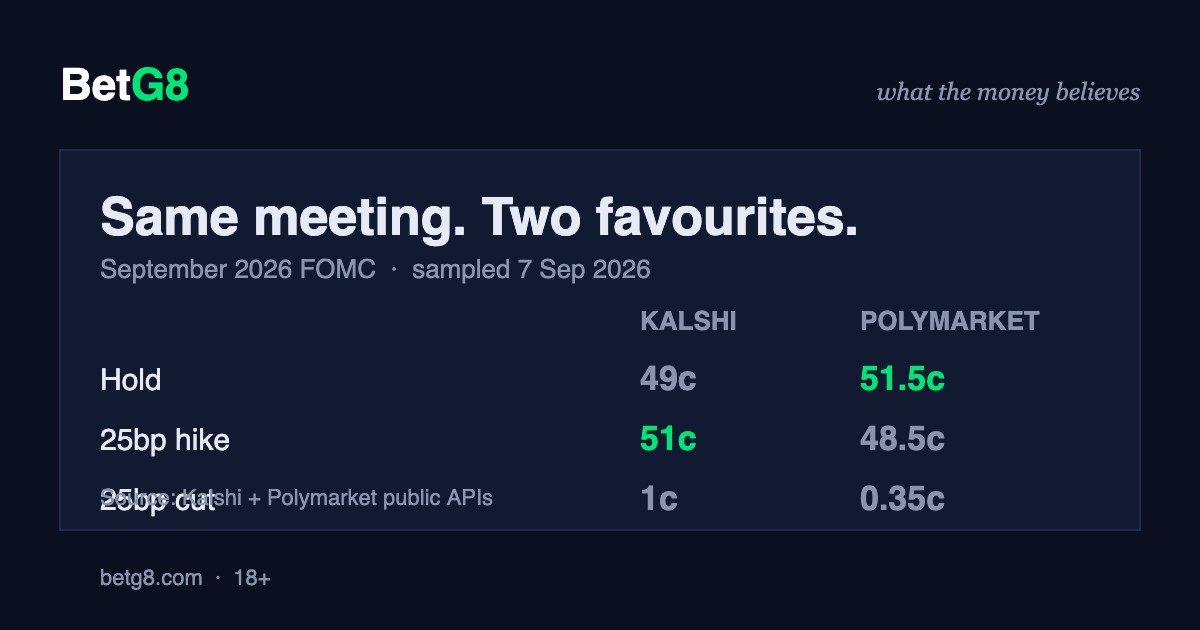
What the two venues were pricing on 7 September 2026
| September 2026 FOMC outcome | Kalshi | Polymarket |
|---|---|---|
| No change (hold) | 49c | 51.5c |
| 25bp increase | 51c | 48.5c |
| 25bp decrease | 1c | 0.35c |
| More than 25bp increase | 2c | 0.55c |
| More than 25bp decrease | 1c | 0.15c |
The two books named different favourites. Kalshi had a 25 basis point increase in front at 51c against a 49c hold. Polymarket had the hold in front at 51.5c against a 48.5c increase. That is a three point gap on the modal outcome of the single most watched macroeconomic event of the month, eight days before it settles.
Depth was not the reason. Polymarket recorded roughly 100.7 million dollars of volume on the September event with about 6.1 million dollars of resting liquidity. On Kalshi the hold contract alone showed 14.8 million dollars of traded notional and 10.1 million dollars of open interest. Both books are liquid by prediction market standards, and they still disagreed.
One detail is worth isolating. On Kalshi the 25 basis point cut contract traded at 1c while still carrying about 6.3 million dollars of open interest. That is a large amount of money sitting in a position the same order book values at a penny.

How far the market has moved
A month earlier this looked like a settled question in the other direction. After a July jobs report that showed 23,000 jobs lost against a forecast of 83,000 gained, Kalshi priced a September hold at 65 percent on 9 August and Polymarket at 63 percent, with the CME FedWatch tool at 55.6 percent. Two weeks before that, the same contract had shown a 23 point spread between venues.
By 7 September the Kalshi hold had fallen from 65c to 49c and an increase had taken the lead, after a payrolls print that ran the other way. Both cut contracts collapsed to a cent or less. The convergence story of early August did not resolve into agreement; it resolved into a near coin flip that the two venues are calling from opposite sides.
How a Fed rate contract settles
On Kalshi the September meeting is a mutually exclusive event under the KXFEDDECISION series. Exactly one of the five contracts can resolve yes, and the exchange rules state that if a scheduled FOMC meeting is cancelled and does not take place on its scheduled date, the hold contract resolves yes and every other contract resolves no. Each contract pays one dollar if it resolves yes and nothing if it does not.
Polymarket runs the equivalent structure as a grouped market with the same five buckets. Both settle against the target range announced in the Federal Reserve statement for the meeting, not against commentary, dot plots or subsequent revisions.
Because the outcomes are mutually exclusive, the five prices on a single venue should sum to about one dollar. In practice they sum slightly above it, because the last traded price of each contract sits somewhere inside its own bid and ask. That gap is the closest thing these venues have to a sportsbook hold, and it is considerably smaller than the hold on a comparable sportsbook line.
Why the two venues can disagree
Kalshi and Polymarket are separate order books with separate participants, separate collateral and no obligation on anyone to keep them aligned. Kalshi is a CFTC designated contract market taking dollar deposits from US customers. Polymarket settles in stablecoin on a public blockchain. Moving capital from one to the other is not instant and is not free.
That friction is why a three point gap can sit there for hours without anyone closing it. Any trader who wanted to act on the difference would need funded accounts on both venues, and would be paying fees on both legs. Neither exchange publishes timestamped order book depth, so it is not possible from outside to say which venue moved first and which followed.
For a fuller comparison of how pricing and costs differ between an exchange and a bookmaker, see our explainer on sportsbooks versus prediction markets and the breakdown of Kalshi and Polymarket fees.
Why state gambling lawsuits do not reach these contracts
Kalshi is being sued or subjected to enforcement in more than a dozen states, and the fight has now reached three federal circuits. The Third Circuit sided with Kalshi against New Jersey in April. The Ninth Circuit ruled for Nevada in August, holding that Kalshi was unlikely to show the Commodity Exchange Act preempted a state licensing requirement. Connecticut sued on 26 August and Kalshi has appealed to the Second Circuit.
Every one of those actions is about sports event contracts. The states argue that a contract on whether a team wins is a sports wager wearing a different label. Nobody in that dispute argues that a contract on the federal funds target range is sports betting, and interest rate contracts are the kind of economic indicator the CFTC framework was built for. That is why the Fed markets have kept trading in states where sports contracts are contested.
We keep a dated record of every state and court action in this fight in the prediction market change log, and the current state by state position in the Kalshi legality tracker.
What the price is not
A contract trading at 51c is not a 51 percent forecast that anyone has validated. It is the price the last buyer was willing to pay, on a book where the bid and ask sit either side of that number. On a thin contract a single order can move the implied figure by several points, and on this event the implied numbers on two venues differ by enough to name different winners.
It is also worth noting the context these markets are trading in. Combined volume across Kalshi and Polymarket fell 14.5 percent in August to 45.33 billion dollars, the first monthly decline in more than a year, with Kalshi at 37.17 billion and Polymarket at 8.16 billion. Falling aggregate volume does not make any individual price wrong, but it is the backdrop against which these books are quoting.
This page describes what the market is doing. It does not tell you what to do about it, and nothing here is trading or betting advice.
How we measured this
Prices were read directly from each venue public API on 7 September 2026, not from a screenshot or a third party aggregator. Kalshi figures come from the events endpoint for KXFEDDECISION-26SEP with nested markets, using the last traded price for each contract plus the reported traded notional and open interest. Polymarket figures come from the Gamma events endpoint for the September Fed decision event, using the last traded price for each outcome plus the event level volume and liquidity fields.
Both venues were sampled within the same minute so the two sides of the comparison are contemporaneous. The prices in the table are venue last traded prices; bid and ask are included in the downloadable file. The 9 August comparison figures are quoted from Prediction News rather than measured by us, and are labelled as such in the file.
The full capture, including bids, asks, per contract volume and open interest, is published as a CSV so the numbers can be checked or reused: download the September 2026 cross venue capture (CSV). Reuse is fine with or without credit.
Frequently asked questions
Can you trade Federal Reserve rate decisions on Kalshi?
Yes. Kalshi lists a mutually exclusive set of contracts for each scheduled FOMC meeting under the KXFEDDECISION series, covering a hold, a 25 basis point move in either direction, and moves larger than 25 basis points. The September 2026 event alone had traded more than 36 million dollars in notional across its five contracts when we sampled it on 7 September 2026.
Does Polymarket have Fed rate markets too?
Yes. Polymarket runs an equivalent multi-outcome market for each meeting. Its September 2026 event had recorded about 100.7 million dollars in volume with roughly 6.1 million dollars of resting liquidity when we sampled it on 7 September 2026.
Are Fed contracts affected by the state lawsuits against Kalshi?
Not directly. The state actions in Nevada, Connecticut, New York and elsewhere target sports event contracts and argue they are unlicensed sports wagering. Interest rate contracts are economic indicators and sit squarely inside the CFTC remit that both sides of the sports dispute accept.
Why do Kalshi and Polymarket show different prices for the same meeting?
Because they are separate order books with separate participants, separate collateral and no shared market maker obligation. Fees, funding costs and the effort of moving money between venues mean a gap can persist without anyone being obliged to close it.
Does a 51 cent price mean a 51 percent chance?
It is the price the last buyer paid, not a forecast anyone has verified. A contract that pays one dollar and trades at 51 cents implies roughly 51 percent before fees, but the bid and ask sit either side of that, and on thin books the implied number can move on a single order.
When is the September 2026 FOMC decision?
The Polymarket contract for the September meeting is dated to 16 September 2026. Both venues settle against the target range announced in the Federal Reserve statement for that meeting.
Sources
- Kalshi public API, event KXFEDDECISION-26SEP with nested markets, sampled 7 September 2026.
- Polymarket Gamma API, event slug fed-decision-in-september-762, sampled 7 September 2026.
- Prediction News, Kalshi and Polymarket converge on September Fed hold odds after jobs miss, 5 August 2026, for the 9 August prices and July payrolls figures.
- The Crypto Basic, Kalshi, Polymarket August volume drops 14.5 percent, 2 September 2026.
- The Hill, Appeals court rules states can regulate prediction market platforms, August 2026.
- Connecticut Attorney General, Connecticut sues Kalshi, 26 August 2026.
18+ only. Prediction market contracts and sports wagering carry real financial risk. This page is analysis, not legal, financial or betting advice. If gambling stops being fun, help is available at 1-800-GAMBLER.