Is Kalshi legal in New Hampshire?
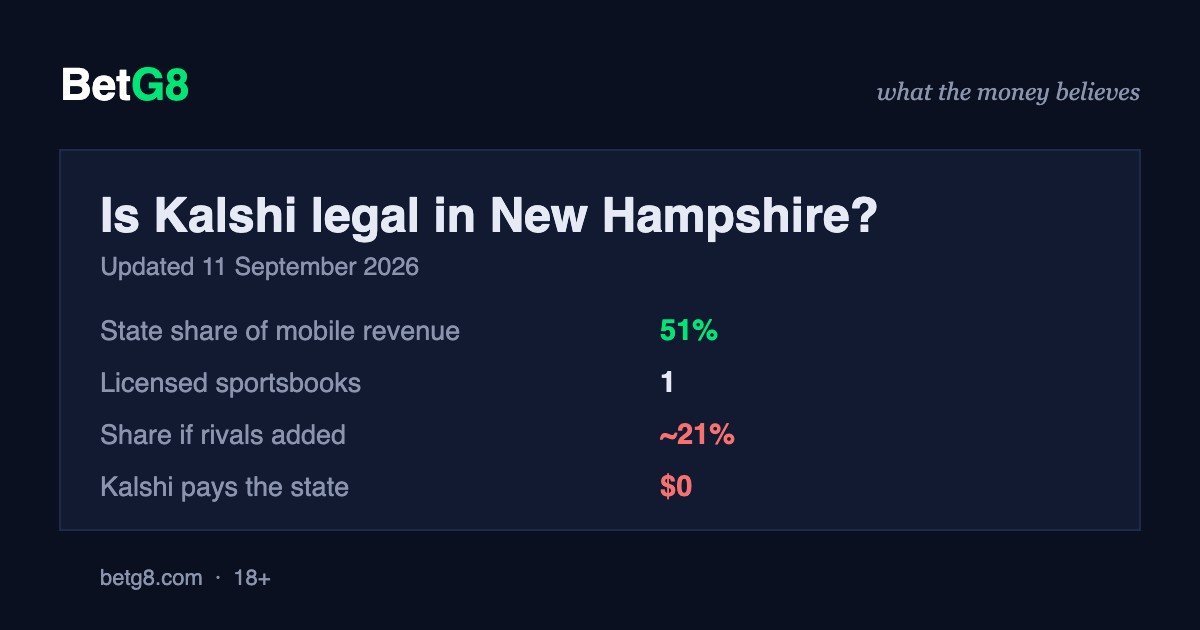
New Hampshire at a glance
| Question | Position as of 11 September 2026 |
|---|---|
| Does Kalshi accept New Hampshire users? | Yes, with no state-specific restriction reported |
| Has New Hampshire issued a cease and desist? | No publicly reported order |
| Is New Hampshire in the Kalshi litigation? | No |
| Licensed online sportsbooks | One - DraftKings, exclusive since 2019 |
| State share of mobile revenue | 51 percent |
| State share of retail revenue | 50 percent |
| Share if competitors are added | About 21 percent |
| Exclusive deal runs to | Summer 2028 |
| Minimum betting age | 18 |

The arithmetic that makes this state unusual
Most states tax sportsbook revenue somewhere between 10 and 20 percent and license a dozen or more operators. New Hampshire did the opposite. In 2019 it auctioned a single exclusive licence covering both online and retail wagering, DraftKings won it, and the winning bid was a revenue share rather than a tax rate: 51 percent of mobile gross gaming revenue and 50 percent of retail. That arrangement has produced more than 172 million dollars for the state to date, and the Lottery Commission has extended it through the summer of 2028.
Now put a federally regulated exchange next to it. Kalshi holds no New Hampshire licence and pays the state nothing. When a New Hampshire resident moves a position from the licensed book to the exchange, the state does not lose a 15 percent tax slice the way Ohio or Illinois would. It loses roughly half of that revenue, because half of it was the states.
That is why New Hampshire has more riding on the outcome of this fight, per dollar wagered, than any other state in the country - and it is also why it has not obviously moved. New Hampshire Public Radio raised the question during March Madness in 2026 of whether prediction markets would deflate the states tournament revenue. The state has still filed nothing publicly.
Why the monopoly is hard to unwind
The contract contains its own trap. The 51 percent share is the price of exclusivity; reporting on the extension indicates the rate falls to roughly 21 percent if additional operators are licensed. Opening New Hampshire to competition would therefore cut the states take per dollar by well over half, and it would need the market to more than double in size just to break even.
So the state is financially locked into a single operator, that operator is locked into a rate no competitor would accept, and the competitive pressure is arriving from a direction neither of them can license or tax. A second sportsbook is the one competitor New Hampshire can keep out. An exchange is not.
The part that is genuinely strange
DraftKings did not sit out the prediction market wave. It launched its own event contract product to compete with Kalshi and Polymarket. But it did not launch it everywhere: certain states are excluded, and New Hampshire is one of them.
The reading that requires the fewest assumptions is that offering unlicensed event contracts in the one state where you hold an exclusive licence, and where you hand the government 51 cents on the dollar of your licensed revenue, is not a trade you want to explain to that government. Whatever the reason, the effect is that New Hampshire residents can trade sports event contracts on Kalshi, and cannot trade them with the company that holds the New Hampshire sports betting monopoly.
This page does not claim to know DraftKings reasoning, and the company has not been asked to state it here. What is on the record is the exclusion itself.
Where the national fight stands
| Circuit | Case | Result |
|---|---|---|
| Third | New Jersey | Ruled for Kalshi, April 2026 |
| Ninth | Nevada | Ruled for the state, August 2026 |
| Second | Connecticut | Kalshi appeal pending |
States with a reported cease and desist or suit include Nevada, New Jersey, Maryland, Montana, Illinois, Ohio, Arizona, Tennessee, Massachusetts, New York and Connecticut. New Hampshire appears on none of them. Every dated action is in the prediction market change log, and the current map is in the Kalshi legality tracker.
Massachusetts sits next door and has acted. If the Second Circuit sides with Connecticut, the pressure on a state collecting 51 cents on the dollar becomes considerable.
What this means in practice
A New Hampshire resident today can open a Kalshi account and can also bet with DraftKings, the only licensed book in the state. Neither fact is a legal opinion, and the first could change on any business day if New Hampshire decides to act, as eleven other states have. Kalshi has geofenced or withdrawn markets in states after orders were issued, so present access is not a guarantee of continued access.
For how the two products differ in cost and structure, see sportsbooks versus prediction markets. This page describes the regulatory position and the money flowing through it. It is not legal advice and not a recommendation to trade or wager anything.
Frequently asked questions
Is Kalshi legal in New Hampshire?
Kalshi operates in New Hampshire and no publicly reported New Hampshire cease and desist order or lawsuit targets it as of 11 September 2026. New Hampshire is not a party to the Kalshi litigation running through the Second, Third and Ninth Circuits.
Who is allowed to take sports bets in New Hampshire?
Only DraftKings. New Hampshire awarded a single exclusive licence in 2019 covering both online and retail sports wagering, and the Lottery Commission has extended that arrangement through the summer of 2028.
How much does New Hampshire take from sports betting?
DraftKings pays 51 percent of mobile gross gaming revenue and 50 percent of retail gross gaming revenue to the New Hampshire Lottery. That has generated more than $172 million in state revenue to date.
Why does New Hampshire keep the monopoly?
Because competition would cost it money. The revenue share drops to roughly 21 percent if additional operators are added, so opening the market would cut the state take per dollar by more than half.
Does DraftKings offer prediction markets in New Hampshire?
No. DraftKings launched its own prediction market product to compete with Kalshi and Polymarket but excluded certain states, New Hampshire among them.
What is the legal betting age in New Hampshire?
New Hampshire sets its sports wagering age at 18, lower than the 21 used by most US states with legal sportsbooks.
Sources
- Gaming America, Why New Hampshire just doubled down on its DraftKings sports betting monopoly, for the 51 and 50 percent shares, the 21 percent fallback and the 2028 extension.
- Gambling News, DraftKings keeps exclusive sports betting deal in New Hampshire.
- New Hampshire Public Radio, Could prediction markets deflate March Madness revenue for NH?, 19 March 2026.
- CNN Business, States can regulate prediction markets as gambling, federal appeals court rules, 28 August 2026.
18+ only. Prediction market contracts and sports wagering carry real financial risk. This page is analysis, not legal, financial or betting advice. If gambling stops being fun, help is available at 1-800-GAMBLER.