Funding rate and liquidation calculator: what a leveraged position really costs
Perpetual futures have two costs that the order ticket does not show you. One is the liquidation price — the level at which the exchange closes the position for you. The other is funding, the periodic payment between longs and shorts that keeps the perpetual pinned to spot. This calculator puts both on one screen: enter the position, the exchange's funding interval and the current rate, and it returns the liquidation price, how far away it is, and what funding costs per day, per month and per year — in dollars and as a share of your margin.
Approximation for an isolated position with no fees: liquidation price = entry × (1 ∓ 1/leverage ± maintenance rate). Exchanges use mark price, deduct taker fees and may use tiered maintenance rates, so the real liquidation level sits slightly closer to entry than shown here. A positive funding rate means longs pay shorts; negative means shorts pay longs.
How the liquidation math works
Your margin is the cushion between the entry price and the point at which the exchange takes over. At 10x leverage you posted 10% of the notional, so a 10% adverse move would wipe it out — but the exchange steps in before zero, at the maintenance margin, typically 0.25% to 1% of notional depending on the asset and the size tier. That is why a 10x long at $100,000 with a 0.5% maintenance rate liquidates near $90,500 rather than $90,000: the exchange keeps the last half a percent to cover the cost of closing you out.
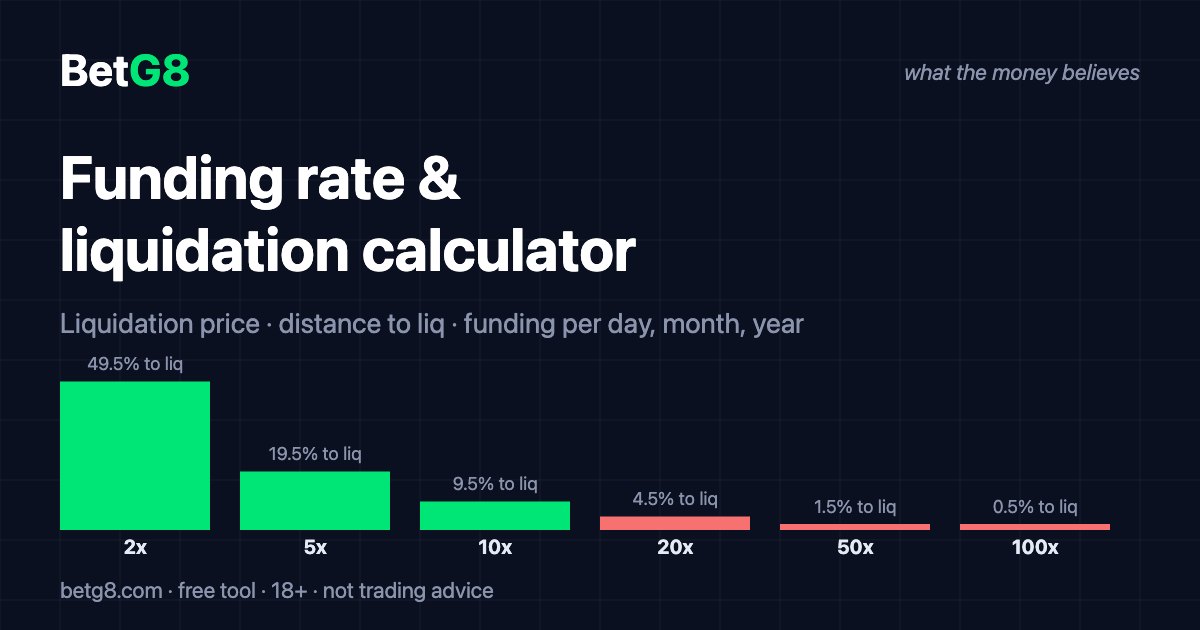
The formula is symmetrical. A long liquidates at entry × (1 − 1/leverage + maintenance rate); a short at entry × (1 + 1/leverage − maintenance rate). The distance to liquidation, expressed as a percentage of entry, is what matters more than the price itself, and it collapses fast as leverage rises:
| Leverage | Initial margin | Distance to liquidation (0.5% maint.) | Long liq. price from $100,000 |
|---|---|---|---|
| 2x | 50% | 49.5% | $50,500 |
| 3x | 33.3% | 32.8% | $67,167 |
| 5x | 20% | 19.5% | $80,500 |
| 10x | 10% | 9.5% | $90,500 |
| 20x | 5% | 4.5% | $95,500 |
| 25x | 4% | 3.5% | $96,500 |
| 50x | 2% | 1.5% | $98,500 |
| 100x | 1% | 0.5% | $99,500 |
At 50x the position survives a 1.5% move, and a 1.5% move is not a rare day in any crypto market. That is the arithmetic behind every "liquidation cascade" headline: the positions that get swept are not wrong about direction so much as they are wrong about how much room an ordinary day needs.
What funding actually costs
Funding is the mechanism that keeps a perpetual contract trading near the spot price. When the perp trades above spot, the rate is positive and longs pay shorts; when it trades below, shorts pay longs. Three things about it are routinely misread.
It is charged on notional, not margin. A 0.01% rate looks harmless until you remember it applies to the whole position. On a $10,000 position that is $1 per payment. If you are 10x levered and posted $1,000, each payment is 0.1% of your capital, and at three payments a day that is 0.3% of your margin daily — roughly 9% a month if the rate holds.
Intervals differ between exchanges. Binance, Bybit and OKX settle every eight hours, so a displayed rate of 0.01% is paid three times a day. Hyperliquid settles every hour but displays the eight-hour-equivalent rate, so a displayed 0.01% is actually paid as 0.00125% per hour, 24 times a day — the same daily cost, differently labelled. The calculator's third interval option handles that conversion so you can compare a Hyperliquid quote with a Binance quote on equal footing. Kalshi's proposed commodity perpetuals settle funding three times a day; we walked through that structure in Kalshi's oil perpetual, explained.
The annualised number is the honest one. 0.01% per eight hours is 1,095 payments a year, or 10.95% annualised, before compounding. That is a baseline rate on a calm market. In a crowded trade the rate can sit at 0.05% to 0.1% for days — 55% to 110% annualised — which is why the funding column on a whale-tracking dashboard often explains a position's fate better than the entry price does. Our August whale board logged an $80.45M BTC long carried at 76,117 while spot sat near 63,000 — roughly 17% underwater. On a position that size, every eight-hour funding payment is a four- or five-figure line item, and it never shows up in a screenshot of unrealised P&L.
Funding moves the liquidation price too
Every funding payment comes out of margin, and margin is what sets the liquidation distance. The calculator's last line shows the effect: it subtracts the projected funding over your holding period from the collateral and recomputes the liquidation price. On a 10x long paying 0.3% of margin a day, thirty days of funding pulls the liquidation price about 0.9% of entry closer. That sounds small until it is the difference between a wick that touches $90,500 and one that touches $91,400.
Where this fits with the rest of the site
The house edge on a sportsbook parlay is visible in the price; we tabulated it in the parlay calculator. The edge on a perpetual is spread across funding, fees and the maintenance cushion, and it is paid continuously rather than once, which is why it is so easy to underestimate. Both markets reward the same habit: work out the cost of the position before you look at the payoff. For converting the prices themselves, the odds converter handles American, decimal, fractional and implied probability; for how exchanges with no vig charge instead, see Kalshi vs Polymarket fees.
FAQ
- How is the liquidation price of a perpetual futures position calculated?
- For an isolated long: entry × (1 − 1/leverage + maintenance rate). For a short: entry × (1 + 1/leverage − maintenance rate). A 10x long at $100,000 with a 0.5% maintenance rate liquidates near $90,500. Fees and mark-price rules move the real level slightly closer to entry.
- What does a funding rate of 0.01% actually cost?
- Charged on notional: a $10,000 position pays $1 per payment. At 8-hour intervals that is $3 a day, about $90 a month, 10.95% annualised — and 0.3% of margin per day on a 10x position.
- Why does Hyperliquid show funding differently from Binance?
- Hyperliquid settles hourly but displays the 8-hour-equivalent rate; Binance and Bybit settle every 8 hours and display the per-interval rate. Annualise both to compare.
- Does funding move my liquidation price?
- Yes. Payments are deducted from margin, so the liquidation price drifts toward entry over time. The calculator's final line shows the drift for your holding period.
18+. This tool performs arithmetic on numbers you enter. It is not a recommendation to open, close or size any position, on any exchange.