What does it actually cost to trade on a prediction market?
What the spread is, and why it is the real price
A prediction market contract pays one dollar if it resolves yes and nothing if it does not. To buy it you pay the ask. To sell it you receive the bid. The gap between those two numbers is what it costs you to enter and leave immediately, before any fee schedule applies. On a one dollar contract the spread in cents is very close to the round-trip cost in percent.
That makes prediction markets unusually easy to price-check compared to a sportsbook, where the margin is folded invisibly into the odds. Here it is two numbers on a screen and you can subtract them yourself.
What we measured
Every open market attached to the 100 highest 24-hour-volume events, read in a single pass on 11 September 2026. Contracts without a live two-sided quote were dropped, leaving 1,728 contracts carrying about 2.51 billion dollars of cumulative volume.
| Contract volume | Contracts | Median spread | Mean spread |
|---|---|---|---|
| Over $1M | 253 | 0.1c | 0.32c |
| $100k - $1M | 242 | 0.3c | 0.63c |
| $10k - $100k | 204 | 1.0c | 1.2c |
| $1k - $10k | 68 | 1.0c | 1.56c |
| Under $1k | 961 | 27c | 44c |
| All contracts | 1,728 | 3.0c | - |
The overall median of 3 cents is the least useful number in that table. It is an average of two populations that have nothing to do with each other: a few hundred institutional-grade order books and a thousand contracts nobody has touched.

Where the money actually is
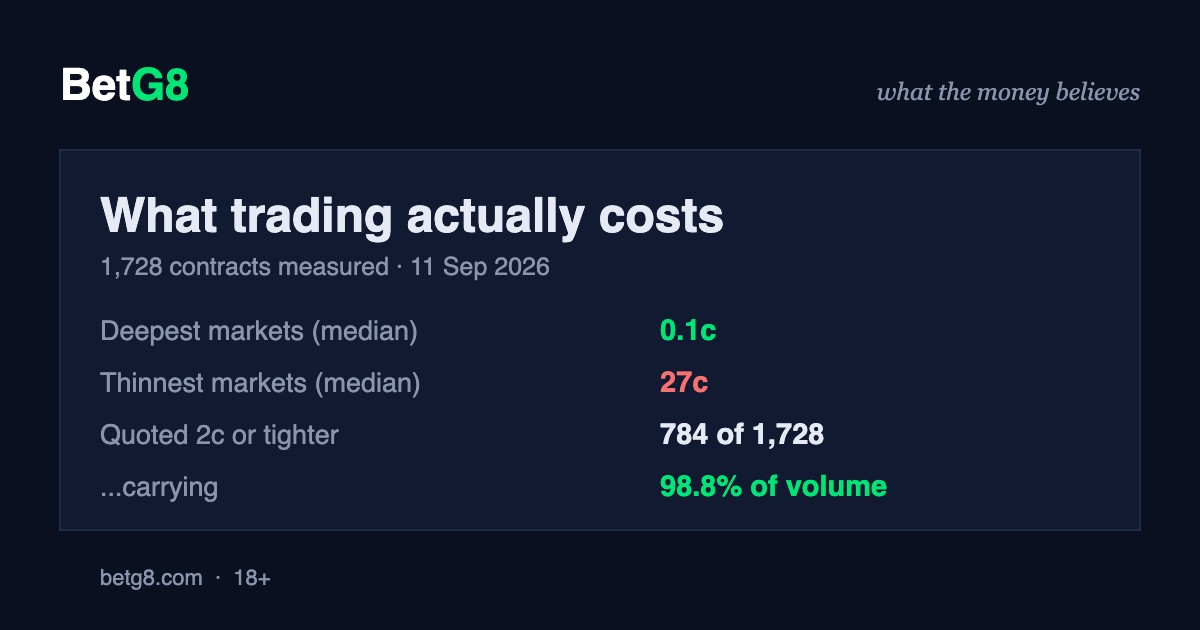
784 contracts - 45.4 percent of the sample - were quoted at two cents or tighter. Those contracts carried 98.8 percent of all the volume in the sample.
That single figure is the fair answer to the cost question. The typical dollar traded on this venue is paying a spread of a fraction of a cent. The typical contract listed is not, but almost nobody is trading it. Anyone describing prediction markets as uniformly cheap is right about the money and wrong about the menu; anyone describing them as illiquid is right about the menu and wrong about the money.
The tightest quotes were in large, long-dated political and macro markets. Contracts on the 2028 presidential nominations were quoted at 0.1 to 0.2 cents on volumes in the tens of millions. A 0.1 cent spread on a fifty cent contract is a round-trip cost of about 0.2 percent.
The 296 contracts that are not really quoted
296 contracts, 17 percent of the sample, showed a bid of two cents or less against an ask of ninety-five cents or more. Every single one of them had under a thousand dollars of volume.
Those are not markets. They are a listing with a nominal quote at each extreme, which produces a midpoint near fifty cents and a spread near a dollar. A screen that shows a price implies a market exists. In these cases the price is a placeholder, the implied probability is meaningless, and anyone reading a midpoint off one of them is reading nothing at all.
We found the same pattern in the NFL prop board, where 130 of 148 listed player props had never traded: can you bet NFL player props on prediction markets.
Compared with a sportsbook
A standard two-way sportsbook line at -110 on both sides carries roughly 4.5 percent hold. That number is remarkably stable, because the book sets it deliberately and applies it to every customer whether the market is busy or dead.
An exchange does not set a margin. It discovers one, and the result is far more variable than any book would tolerate. On a heavily traded contract the customer pays roughly a twentieth of the sportsbook margin. On a dead contract the customer pays several times it, or simply cannot transact at size.
The honest summary is that prediction markets are much cheaper where there is a crowd and much worse where there is not, and the deciding factor is not the venue but the specific contract. Exchange fee schedules sit on top of this and are published separately by each venue: see the Kalshi and Polymarket fee comparison and the broader structural comparison.
Method and limits
Source: the Polymarket Gamma public API, read on 11 September 2026. We pulled the 100 events with the highest 24-hour volume and every market attached to them, then kept only contracts reporting both a best bid and a best ask above zero with the ask above the bid. That left 1,728 of the contracts returned. Spread is best ask minus best bid, expressed in cents on a one dollar contract. Volume is the venue reported per-market cumulative figure in US dollars.
Three limits worth stating. This is a top-of-book measurement, so it says nothing about how much size sits at those prices or how far the price moves on a large order. It is a single snapshot, and spreads move with news and with time to resolution. And it covers one venue - Kalshi was not included, because its public API was not returning listings to us when this page was written, so nothing here should be read as a statement about Kalshi spreads.
The band table and the underlying counts are published as a CSV: download the spread capture (CSV). Reuse is fine with or without credit.
Frequently asked questions
What does the bid-ask spread cost you on a prediction market?
On a contract that settles at one dollar, the spread is the round-trip cost of entering and leaving immediately. Across 1,728 live contracts the median spread was 3 cents, but contracts over $1M of volume had a median of 0.1 cents while contracts under $1k had a median of 27 cents.
Are prediction markets cheaper than a sportsbook?
In the deepest markets, dramatically so. A -110 two-way line carries roughly 4.5 percent hold; a 0.1 cent spread near fifty cents is about 0.2 percent. In the thinnest contracts the comparison reverses completely.
How much of the money is in the tight markets?
Almost all of it. The 784 contracts quoted at two cents or tighter, 45 percent of the sample, accounted for 98.8 percent of the roughly $2.5 billion of volume.
What is a placeholder quote?
A contract nobody has traded where a quote still appears. We found 296 contracts quoted at 2c or less bid against 95c or more ask, all with under $1,000 of volume. A price being displayed does not mean a market exists.
Does the spread include exchange fees?
No. The spread is the cost of crossing the book. Fee schedules are separate and published by each venue. On a thin contract the spread is usually the dominant cost.
How was this measured?
Every open market attached to the 100 highest 24-hour-volume events on the Polymarket Gamma public API was read in one pass on 11 September 2026. Contracts without a two-sided quote were excluded, leaving 1,728. Spread is best ask minus best bid.
Sources
- Polymarket Gamma public API, events endpoint ordered by 24-hour volume plus all attached markets, sampled 11 September 2026. All spread, volume and liquidity figures on this page come from that single pass.
- BetG8, NFL player prop liquidity, 10 September 2026.
- BetG8, sportsbooks versus prediction markets.
18+ only. Prediction market contracts and sports wagering carry real financial risk. This page reports measured order book conditions on one date; it is not legal, financial or betting advice, and it is not a recommendation to take any position. If gambling stops being fun, help is available at 1-800-GAMBLER.