The Fed hiked. Here is the prediction market scorecard.
What the markets said, and when
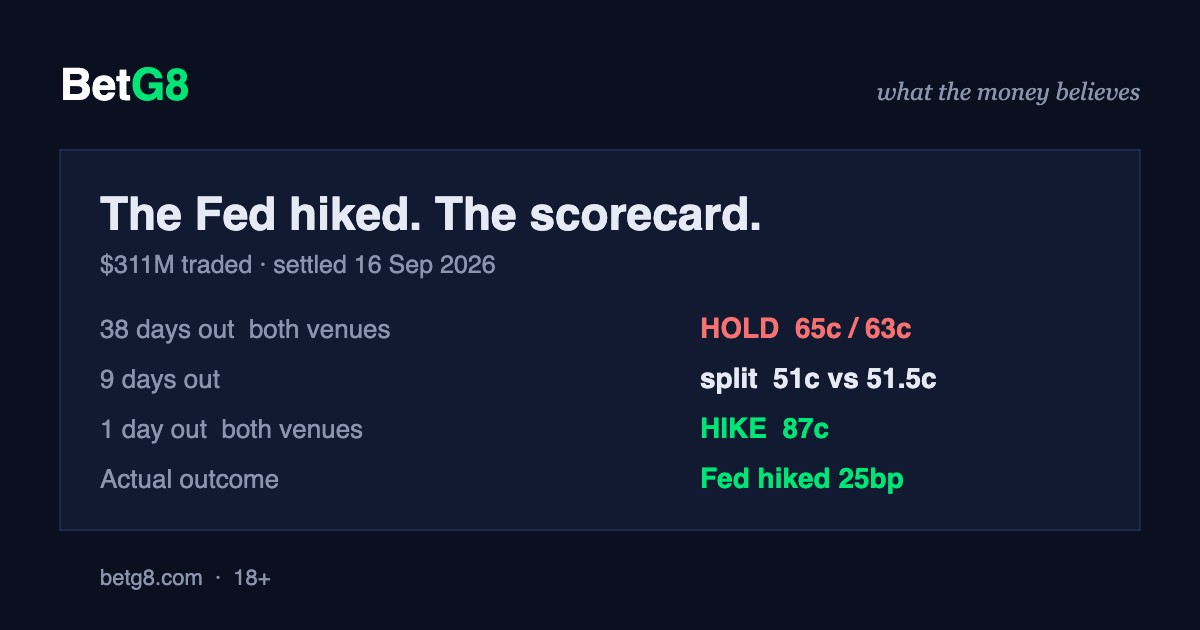
| Date | Days out | Kalshi favourite | Polymarket favourite |
|---|---|---|---|
| 9 August | 38 | Hold, 65c | Hold, 63c |
| 7 September | 9 | Hike, 51c | Hold, 51.5c |
| 15 September | 1 | Hike, 87c | Hike, 87c |
| 16 September | 0 | Fed raises 25bp - hike resolves yes | |
Read top to bottom that is a market that was confidently wrong, then split, then confidently right, over five weeks. The 9 August figures are quoted from Prediction News, which reported a CME FedWatch reading of 55.6 percent for a hold at the same time. The September figures we measured ourselves from each venue public API on the day.
The honest summary is not that prediction markets are clairvoyant. On 9 August, a month and a bit out, both venues had roughly a two-in-three chance on the outcome that did not happen, and so did the CME futures curve. What they did well was update fast once the payrolls data moved against them.

The moment the two venues disagreed
The interesting row is 7 September. Kalshi had the hike in front by two cents; Polymarket had the hold in front by three. Not a rounding difference - they named different favourites for the same event nine days out, while carrying a combined 136 million dollars of volume between them.
We published that disagreement on the day, before knowing how it would land: can you trade Fed rate decisions on Kalshi and Polymarket, and followed the convergence on the eve of the meeting in when two prediction markets disagree, which one is right. Kalshi was the venue pointing at the outcome that happened.
That is worth exactly what a single event is worth, which is not much. A two cent edge resolving correctly is what chance produces roughly half the time. It is one data point in what we intend to make a longer series, not a verdict on either venue.
Where the money went, and how much of it was wrong
| Contract | Kalshi volume | Polymarket volume | Result |
|---|---|---|---|
| No change (hold) | $48.29M | $56.44M | No |
| 25bp increase | $18.77M | $42.16M | Yes |
| More than 25bp increase | $19.95M | $33.43M | No |
| 25bp decrease | $13.83M | $56.26M | No |
| More than 25bp decrease | $2.37M | $19.74M | No |
| Total | $103.2M | $208.0M |
About 311 million dollars traded across the two venues on a single Federal Reserve meeting. The detail worth pausing on is that on both venues the winning contract was only third by volume. The two busiest Kalshi contracts were the hold and a move larger than 25 basis points, both losers. On Polymarket the two busiest were the hold and a 25 basis point cut, both losers, and the cut had been trading at a fraction of a cent for the final week while still accumulating 56 million dollars of turnover.
That is not a scandal, it is how these books work. Volume accumulates over the whole life of a contract, including the weeks when the losing side looked reasonable, and a contract priced near zero still trades as holders close out. But it does mean volume is a poor guide to what a market believes. Price is the belief; volume is the history of everyone who believed something else along the way.
What we would take from this
Late convergence is not foresight. Both venues were near-certain a day out, which is the easiest moment to be right. The forecast that would have been worth something was on 9 August, and it was wrong on both venues and on the CME curve too.
Reading one venue is reading half the market. For at least a day, a screenshot of either exchange would have told you the opposite of the other about which outcome was favourite.
Score the record, do not remember it. Every number here was published before the answer was known, with timestamps and a downloadable file. That is the only way a claim about market accuracy means anything, and we will keep doing it for the October and December meetings.
Method
Resolution status and final prices were read from the Kalshi public API for event KXFEDDECISION-26SEP and the Polymarket Gamma API for the September Fed decision event on 17 September 2026, after both had finalised. The 7 and 15 September figures were measured on those dates by the same method. The 9 August figures are quoted from Prediction News and were not measured by us; they are labelled as such in the data file.
Volumes are the venue reported per-contract cumulative figures in US dollars at settlement. Kalshi and Polymarket structure their contracts identically for this event, five mutually exclusive outcomes, which is what makes the two columns comparable.
The full series across all four dates is published as a CSV: download the scorecard (CSV). Reuse is fine with or without credit.
Frequently asked questions
What did the Federal Reserve decide in September 2026?
It raised the target rate by 25 basis points. Both Kalshi and Polymarket have finalised their September contracts with the 25 basis point increase resolving yes.
Did prediction markets get it right?
At the end, yes. On the eve of the meeting both venues priced the hike at 87 to 88 cents. Five weeks earlier they had it backwards: on 9 August Kalshi priced a hold at 65c and Polymarket at 63c.
Which venue called it earlier?
Kalshi. On 7 September it priced the hike at 51c against a 49c hold while Polymarket had the hold in front at 51.5c.
How much money traded on it?
About $311 million across the two venues - roughly $208.0M on Polymarket and $103.2M on Kalshi.
Which contracts attracted the most money?
Losing ones. On both venues the winning contract was only third by volume. The largest Kalshi contract was the hold at $48.3M; the largest two on Polymarket were the hold at $56.4M and a 25bp cut at $56.3M.
Does this prove prediction markets are accurate?
No. One event is an anecdote. The value is that the whole sequence was timestamped in public before the outcome was known, so it can be scored honestly rather than remembered selectively.
Sources
- Kalshi public API, event KXFEDDECISION-26SEP with nested markets, sampled 7, 15 and 17 September 2026. Final status finalized, settlement value Hike 25bps.
- Polymarket Gamma API, event slug fed-decision-in-september-762, sampled 7, 15 and 17 September 2026. Event closed, 25 bps increase resolved to 1.
- Prediction News, Kalshi and Polymarket converge on September Fed hold odds after jobs miss, 5 August 2026, for the 9 August prices and the CME FedWatch reading.
18+ only. Prediction market contracts carry real financial risk. This page reports settled results and measured prices; it is not financial, legal or betting advice. If gambling stops being fun, help is available at 1-800-GAMBLER.