Kalshi's oil perpetual, explained: what a WTI contract that never expires means on a CFTC exchange
On September 2, Bloomberg reported that Kalshi will ask the CFTC to approve a perpetual futures contract on West Texas Intermediate crude — a contract with no expiry date, trading 24 hours a day, five days a week. The filing is expected as soon as the week of September 8. Kalshi has offered a bitcoin perpetual since June 3; this would be the first perpetual on a physical commodity to be listed on a regulated US venue. The instrument itself is not new. Offshore crypto venues have run perpetuals for a decade. What is new is the underlying, the regulator, and the company doing it.
Three instruments, one table
Kalshi now sits across three product types that are easy to confuse. The differences are structural, not cosmetic.
| Feature | Event contract | Dated future | Perpetual future |
|---|---|---|---|
| Expiry | Fixed — settles when the event resolves | Fixed — monthly or quarterly | None |
| Settlement value | $1 or $0 | Converges to spot at expiry | Never settles; funding keeps price near spot |
| Price range | 0–100¢ | Tracks the underlying | Tracks the underlying |
| Carrying cost | None (capital tied up until resolution) | Embedded in the futures curve (contango / backwardation) | Explicit — paid or received as funding |
| Roll needed | No | Yes, before each expiry | No |
| Kalshi status | Live since 2021; sports contracts contested in 20+ suits against Kalshi and Polymarket | Not offered | BTC live since Jun 3, 2026; WTI filing expected |
How a funding rate replaces an expiry date
A dated future has a built-in discipline: on the last trading day it must equal the spot price, so any gap between futures and spot closes by itself. Remove the date and you need something else to close the gap. That something is funding. At fixed intervals, the venue compares the perpetual's own trading price to a reference index. If the perpetual is trading above the index, holders of long positions pay holders of short positions a small percentage of their position. If it trades below, shorts pay longs. Nobody pays the exchange; the money moves between traders. The payment makes the crowded side of the trade slightly expensive to hold, which pulls the price back toward the index.
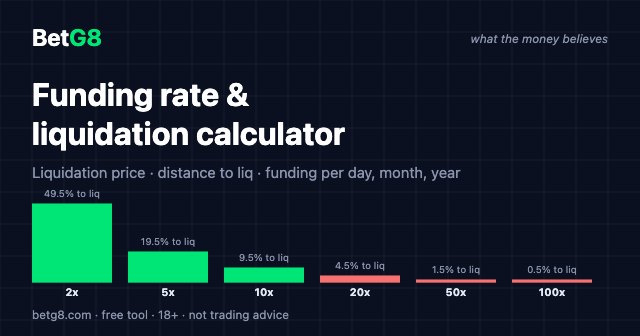
The arithmetic is small per interval and large per year. On Kalshi's BTC perpetual, funding is exchanged at 12:00 AM, 8:00 AM and 4:00 PM ET, and each payment is capped at 2% of position value in either direction. A trader holding a $10,000 long while the rate sits at 0.01% per interval pays $1 every eight hours — $3 a day, or roughly 10.95% annualised if the rate never moved. That is the carrying cost a dated future would have hidden inside the spread between two contract months; the perpetual prints it on your statement three times a day.
| Venue | Funding interval | Reference price | Regulator |
|---|---|---|---|
| Kalshi (BTCPERP) | Every 8 hours, capped ±2% | CF Benchmarks BRTI, updates every second | CFTC — designated contract market |
| Hyperliquid | Every hour (the displayed 8-hour rate is paid in hourly instalments) | Oracle built from major spot exchange prices | Offshore, no US registration |
| Coinbase Financial Markets (Deribit perps via FCM) | Hourly | Deribit index | CFTC no-action relief, Letter 26-17 |
The comparison matters for one reason: Kalshi is importing a mechanism that crypto venues refined on assets that trade continuously, everywhere, with a public price every second. Oil does not.
Why oil is a different animal from bitcoin
When the CFTC approved BTCPERP on May 29, it said out loud why it was comfortable. Bitcoin's spot market is deep, distributed across many venues, and trades around the clock, so the reference price is always observable and expensive to manipulate. The order was limited to "digital commodities" with those properties, and the Commission published a separate policy statement the same day saying that perpetuals on other asset classes — agricultural products, metals, equities, narrow-based indexes — each need independent analysis and should come in through the voluntary Regulation 40.3 review rather than self-certification. Oil is in that second bucket.
Three practical problems follow. First, the reference price. WTI's benchmark is itself a futures contract — the CME front month — which trades roughly 23 hours a day, five days a week, and rolls monthly. A perpetual that funds against a rolling futures contract inherits the roll, which is the thing perpetuals were supposed to eliminate. The reported 24/5 schedule, rather than 24/7, is the tell: the contract can only be as continuous as its index. Second, the physical layer. Crude has storage costs, delivery points and a curve shape that carries real information; in April 2020 the expiring May WTI contract settled at −$37.63 because nobody could take delivery at Cushing. A funding rate can track a curve, but it cannot abstract away the fact that the underlying is a barrel in a tank. Third, the regulator's mood. In June the CFTC asked for public comment on 24/7 trading and on perpetuals linked to storable energy commodities; in July it halted a CME self-certification that would have introduced 24/7 crude futures while it reviewed the product. Kalshi is filing into an open question, not a settled one.
Timeline: how Kalshi got from event contracts to oil perps
| Date | What happened |
|---|---|
| Apr 2025 | Bitnomial self-certifies the first US perpetual (BTC/USD) under Regulation 40.2. |
| May 29, 2026 | CFTC approves Kalshi's BTCPERP under Regulation 40.3, issues a policy statement on perpetuals, and grants Coinbase no-action relief for Deribit perps. |
| Jun 3, 2026 | BTCPERP goes live: 0.0001 BTC per contract, USD-margined, cleared by Kalshi Klear. |
| Jun 9, 2026 | CNBC reports perps crossed $1 billion in volume within a week of launch. |
| Jun 2026 | CFTC requests comment on 24/7 trading and on perpetuals tied to storable energy commodities, including crude. |
| Jul 2026 | CFTC halts a CME self-certified 24/7 crude oil futures listing pending review. |
| Aug 18, 2026 | CNBC: Kalshi wants to launch perps tied to equity indexes. |
| Aug 24, 2026 | Ondo Finance files comment letters urging the SEC and CFTC to bring single-stock perpetuals onshore. |
| Sep 2, 2026 | Bloomberg: Kalshi to file a WTI perpetual with the CFTC as soon as the following week; 24/5 trading per Reuters. |
Where this touches the gambling fight
It is the same company, the same statute and, oddly, the same word. In the state cases, Kalshi's core argument is that its sports event contracts are "swaps" under the Commodity Exchange Act, so only the CFTC can regulate them. The Ninth Circuit rejected that on August 28, holding that a sports contract is not a swap; New Jersey asked the Supreme Court to settle it on September 2. In the perpetuals file, Kalshi argued — and the CFTC agreed — that a contract with no end date is still a "future" because futurity means value set in the future, not a date on a calendar. Both arguments are about what a word in the CEA covers. One is going well for Kalshi; the other is going to the Supreme Court. The oil filing lands in the middle of that, and it is a reminder that Kalshi's regulatory strategy is a single bet placed twice: that the federal definition wins.
For a trader, the distinction is not academic. Event contracts settle at $1 or $0 and cannot lose more than the stake. A perpetual is leveraged, funded and liquidatable. The same app, the same login, and a very different risk surface. That is why the CFTC's policy statement leans on customer-protection questions as much as on market structure.
What to watch
Three dates and one number. The filing itself, expected the week of September 8, will show the reference index, the funding schedule and the position limits Kalshi is proposing for oil. The Regulation 40.3 review gives the Commission 45 days from receipt, extendable, so an answer before late October would be fast. The June comment docket on energy perpetuals is the third: if the Commission moves on the general question first, the Kalshi filing becomes a test case for the rule rather than a one-off. The number is the funding rate on BTCPERP over the next month. If Kalshi's crypto perp keeps its price within a few basis points of the BRTI without the cap binding, that is the operational evidence the oil contract will be judged against.
This page will be updated when the filing is public. We do not trade these contracts and we do not suggest you should; the point of the page is to make the mechanism legible before the marketing does.

FAQ
- What is a perpetual futures contract?
- A futures contract with no expiry date. Instead of converging to the spot price at settlement, it uses a periodic funding payment between long and short holders to keep its price close to a reference index. It was described by economist Robert Shiller in 1992 and popularised by offshore crypto exchanges from 2016 onward.
- Does Kalshi already offer perpetual futures?
- Yes. The CFTC approved Kalshi's bitcoin perpetual (BTCPERP) on May 29, 2026 and it went live on June 3, 2026. It is USD-margined, sized at 0.0001 BTC per contract, funds every eight hours against the CF Benchmarks BRTI, and is cleared by Kalshi Klear. Kalshi has said it plans more than a dozen crypto perpetuals pending approvals.
- Is the WTI oil perpetual live?
- No. As of September 4, 2026 it has not been filed. Bloomberg reported on September 2 that Kalshi plans to submit it to the CFTC as soon as the week of September 8. Because the CFTC's May 29 order covered only digital commodities, an oil perpetual needs a separate Regulation 40.3 review before it can list.
- How is a funding rate different from a fee?
- A fee goes to the exchange. Funding goes from one side of the market to the other — longs to shorts when the perpetual trades above the index, shorts to longs when it trades below. On Kalshi it is exchanged three times a day and capped at 2% of position value per interval. Over a year even a small rate compounds into a real carrying cost.
- Why does the oil contract trade 24/5 instead of 24/7?
- Because its reference price does not exist on weekends. WTI's benchmark is the CME front-month future, which trades about 23 hours a day, Sunday evening to Friday afternoon. A perpetual can only fund against a price that is actually being printed, so its hours follow the index. Bitcoin's spot market never closes, which is why BTCPERP can be 24/7.
- Is this related to the state lawsuits over Kalshi's sports contracts?
- Legally distinct, strategically linked. The sports cases turn on whether event contracts are "swaps" under the Commodity Exchange Act; the perpetuals question turned on whether a contract with no end date is a "future". Both are arguments that federal definitions, not state ones, govern what Kalshi lists. The Ninth Circuit ruled against Kalshi on the first question on August 28, 2026; New Jersey petitioned the Supreme Court on September 2.
Sources
- Bloomberg: Kalshi seeks never-expiring oil futures amid 24/7 trading debate (Sept. 2, 2026)
- Cointelegraph via TradingView: Kalshi seeks CFTC approval for WTI crude perpetual futures
- Kalshi Help Center: BTC perpetual futures contract specifications
- Kalshi News: Kalshi launches first-ever perpetual futures in America (May 29, 2026)
- Katten: Perpetual futures come onshore — the CFTC's new regulatory framework (June 4, 2026)
- CFTC: Order approving KalshiEX LLC BTCPERP futures contract (May 29, 2026)
- CNBC: Kalshi perps cross $1 billion in volume within a week of launch (June 9, 2026)
- CNBC: Kalshi wants to launch perps tied to equity indexes (Aug. 18, 2026)
Next: Kalshi vs Polymarket fees compared →
Related on BetG8
 Funding rate and liquidation calculator
 Kalshi vs Polymarket fees compared: what a trade actually costs in 2026
 The top BTC long changed hands. The short didn't blink.
 Sportsbook vs prediction market: which one actually gives you a better price?
 The market repriced the Supreme Court in one hour — and moved the calendar by zero