States are beating Kalshi 19–4. The coverage says the opposite.
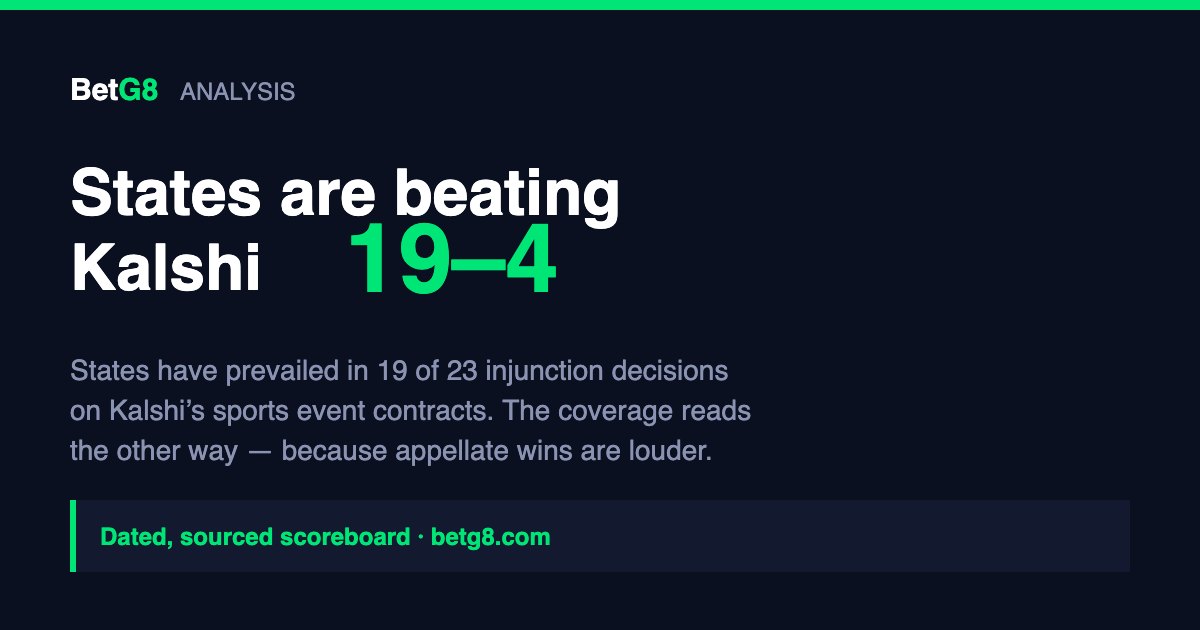
If you have followed this story through headlines, you probably believe Kalshi is winning. Federal preemption, the CFTC riding in with emergency orders, a Third Circuit ruling that read like a rout. The record says something else. Across the injunction decisions involving Kalshi’s sports event contracts, states have prevailed in 19 of 23.
The scoreboard
Selected decisions, newest last. Every row links its source.
| Jurisdiction | Date | Won by | What the court did |
|---|---|---|---|
| Massachusetts | 22 Jan 2026 | State | Preliminary injunction. Judge Christopher K. Barry-Smith held the CEA does not preempt the Massachusetts Sports Wagering Law. Sports contracts barred until Kalshi is licensed. [Massachusetts AG] |
| New Jersey | 6 Apr 2026 | Kalshi | Third Circuit affirmed an injunction against the state — Kalshi shown likely to succeed on CEA preemption. [Justia] |
| Arizona | May 2026 | State | 20-count criminal indictment; permanently enjoined. [Epstein Becker Green] |
| Michigan | 30 Jun 2026 | State | Temporary restraining order barring Kalshi from offering or advertising sports event contracts. [Spectrum News] |
| Minnesota | Jul 2026 | Kalshi | The state criminal ban was frozen before it took effect. [Lines.com] |
| Washington | 21 Jul 2026 | State | Preliminary injunction. King County Judge John McHale found the sports offering likely amounts to illegal gambling. [Covers] |
| Connecticut | 10 Aug 2026 | State | Kalshi denied. The court held sports event contracts are not swaps and are not shielded from state gambling law. [Covers] |
| Washington | 12 Aug 2026 | State | Final order: IP/residency geofence by 19 August, comprehensive geofence by 2 September, $120,000 a day thereafter. Commodities, climate, economics and finance carved out. [GeekWire] |
Why the record and the narrative point in opposite directions
The explanation is not media bias. It is that the wins are structurally louder than the losses.
When the Third Circuit affirmed for Kalshi in April, it produced precedent. That opinion binds three states, gets briefed into every other case, and gives every subsequent Kalshi filing a citation to lead with. It is the kind of thing law firms write client alerts about. When a King County judge grants an injunction, it binds one state and produces a news item.
So the appellate wins accumulate as weight while the trial-level losses accumulate as volume, and coverage naturally tracks weight. A reader ends up with an accurate impression of the legal argument’s trajectory and an inaccurate impression of the map.

What 19–4 does and does not mean
It does not mean Kalshi is losing the war. Preemption is decided in appellate courts, and the one appellate court to rule squarely on it went Kalshi’s way. The Fourth Circuit heard the Maryland appeal on 7 May and has not ruled; that decision alone would bind Maryland, Virginia, the Carolinas and West Virginia.
What it does mean is that the operational picture is much worse for Kalshi than the legal-theory picture. Massachusetts has been closed to sports contracts since January. Michigan issued a restraining order in June. Washington’s comprehensive geofence is due 2 September with a $120,000-a-day penalty attached. Those are markets switched off now, regardless of how the preemption question eventually resolves.
The detail almost every summary drops
The Washington order carves out commodities, climate, economics and finance. The court did not hold that event contracts are gambling. It held that these particular contracts — the ones that function like a sportsbook — are.
That distinction is the whole fight, and it is why Minnesota’s blanket criminal ban was frozen while Washington’s narrow order stands. Courts have been consistently unwilling to say prediction markets are gambling, and consistently willing to say sports contracts are. States that draft to that line win. States that overreach lose.
Frequently asked questions
- How many of these cases has Kalshi lost?
- As of 22 August 2026, states have prevailed in 19 of 23 injunction decisions involving Kalshi’s sports event contracts. Kalshi’s wins are real but few — the Third Circuit ruling out of New Jersey is the most significant.
- Then why does coverage read as though Kalshi is winning?
- Because the wins are structurally louder. A Third Circuit opinion on federal preemption is precedent that binds three states and shapes every other case; a county-level injunction binds one state. Appellate wins get written up as landmarks, trial-level losses get written up as news items. Volume and weight are different things.
- Is Kalshi actually switched off anywhere?
- Yes. Massachusetts has barred sports contracts since January. Washington’s final order requires a comprehensive geofence by 2 September, with a $120,000-a-day penalty attached. Michigan issued a restraining order in June. Arizona enjoined Kalshi permanently in May.
- Does the Washington order ban prediction markets entirely?
- No, and this is the detail most summaries drop. Commodities, climate, economics and finance are explicitly carved out. The court did not rule that event contracts are gambling — it ruled that these particular contracts, the ones that function like a sportsbook, are.
- What would reverse the trend?
- A federal appellate ruling that binds broadly. The Fourth Circuit heard Kalshi’s Maryland appeal on 7 May 2026 and has not ruled; that decision would bind Maryland, Virginia, the Carolinas and West Virginia at once. A CFTC rulemaking or an act of Congress would settle it nationally.
Method and limits
The 19–4 figure is as reported by FinanceFeeds in its coverage of the Washington ruling. We have not independently docket-checked all 23 decisions and we are not presenting the table above as the complete set — it is the subset we can source individually. Counts of this kind are sensitive to what you classify as a decision, so treat the ratio as directional rather than exact.
Every dated event we track is published as an open CSV under CC BY 4.0 in our prediction market change log. If you find a decision we have missed or dated wrongly, we would rather know — corrections are logged and rows are fixed in place.