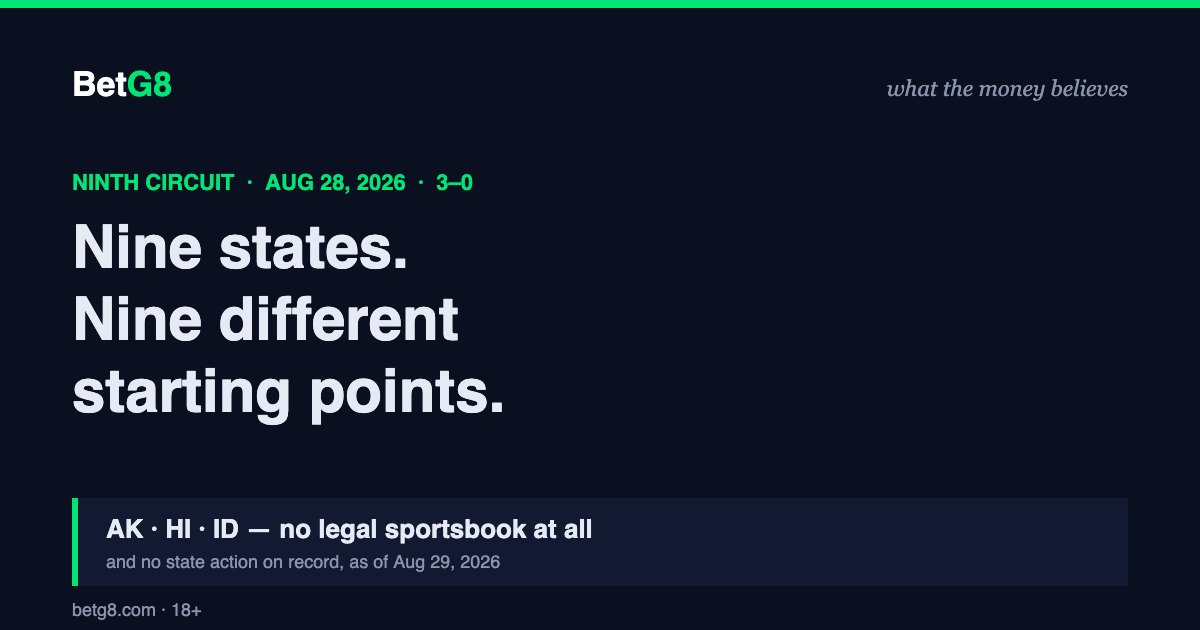
The Ninth Circuit covers nine states. Here is what its Kalshi ruling changes in each one.
What the court actually held
The panel — Ryan D. Nelson, who wrote the opinion, Bridget S. Bade and Kenneth K. Lee — accepted that federal law preempts state law for swaps traded on a designated contract market, and then held that sports event contracts are not swaps. Three moves did the work.
- “Event” and “occurrence” are different words. Congress used both in the swap definition, so it must have meant them to carry different meanings.
- A definition broad enough to cover a table tennis match “lacks a limiting principle.” On Kalshi’s reading, the panel noted, every sportsbook in the country would be an unregistered swaps dealer.
- CFTC Rule 40.11(a) still bars gaming contracts. The discretionary review in 40.11(c) was never invoked for Kalshi’s sports contracts, and the CFTC’s proposed replacement rule has no legal effect until it is adopted.
The reasoning runs directly against the Third Circuit’s April decision in KalshiEx v. Flaherty rather than deciding a different point — which is what makes it a genuine circuit split rather than two courts talking past each other.

The nine states, and how far each one has to travel
The Ninth Circuit covers Alaska, Arizona, California, Hawaii, Idaho, Montana, Nevada, Oregon and Washington. The column that usually gets left out of these tables is the third one.
| State | Where it stood before August 28 | Legal sportsbooks in state? | What the ruling changes |
|---|---|---|---|
| Nevada | Sports, election and entertainment contracts barred under a preliminary injunction entered May 18, 2026. | Yes | Nothing immediately. The ruling affirms the ban Nevada already had, and ends Kalshi’s appeal of it. |
| Washington | Contracts barred under a preliminary injunction. Comprehensive geofence due September 2, with $120,000 a day attached. | Yes | Nothing immediately, but it strengthens the state’s hand in the compliance fight. |
| Montana | Gambling Control Division issued a second cease-and-desist on April 6, 2026; sports contracts reported unavailable. Kalshi sued the attorney general; its injunction request was denied on August 28. | Yes, through the state lottery monopoly | Removes the preemption argument Kalshi was relying on in its own pending case. |
| Arizona | A 20-count criminal case was blocked by a federal TRO in April 2026 and permanently enjoined in May. | Yes | Reopens the question. That injunction rested on preemption reasoning the Ninth Circuit has now rejected. |
| California | No state enforcement action. Three tribes lost a preliminary-injunction bid in November 2025; the appeal is pending at the Ninth Circuit. | No | The most direct effect of all nine. The tribes’ pending appeal is now governed by this precedent. |
| Oregon | No-action state. No cease-and-desist, no suit, no public enforcement action on record as of August 19, 2026. | Yes, lottery-run; all college sports betting is banned | Hands the Oregon DOJ a clean legal path it did not have last week. |
| Alaska | No action on record. | No | Kalshi is the only way to bet on a game in Alaska. The state now has a tested tool to change that. |
| Hawaii | No action on record. | No — no legal gambling of any kind | Same as Alaska, and starker: there is no regulated alternative to point residents toward. |
| Idaho | No action on record. | No | Same as Alaska. A constitution that restricts gambling broadly, and now a circuit precedent that says it can be enforced here. |
The three states nobody is writing about
Alaska, Hawaii and Idaho share a fact that none of the other six do: there is no legal sportsbook in any of them. Hawaii is one of only two states in the country with no legal gambling of any kind. Idaho has tribal casinos but no sports wagering and no bill introduced. Alaska’s most recent legalisation bill, HB 145, was introduced in March 2025 and has not advanced.
That produces an outcome the enforcement states do not have. In Nevada, blocking a prediction market pushes a bettor toward a licensed sportsbook down the road. In Hawaii, blocking a prediction market pushes a bettor toward nothing at all — or toward an offshore book, which is the argument prediction markets have been making about themselves for two years. Whatever a state decides to do with that, the decision now sits with three attorneys general who, until Friday, had no tested legal instrument to act with.
The two where nothing changes
Nevada and Washington already bar the contracts under preliminary injunctions. For Nevada the ruling is the end of an appeal rather than the start of anything: the injunction entered on May 18, 2026 stands, and Kalshi has exhausted the panel stage. For Washington, the immediate calendar item is unrelated to the appeal — the comprehensive geofence deadline is September 2, with $120,000 a day attached if it is missed.
The four in between
California is the one to watch, because the tribes’ appeal is pending in this circuit and is now governed by this precedent. Arizona is the strangest: the state brought the only criminal case in the country, lost it to a federal injunction in May, and that injunction was built on preemption reasoning this panel has now rejected. Montana and Oregon sit at opposite ends of the same spectrum — Montana has been litigating since April and had its own injunction request denied the same day the appellate ruling landed, while Oregon has done nothing at all and now has a clean path if it wants one.
What happens next, with dates
New Jersey’s deadline to petition the Supreme Court for review in Flaherty is September 3, 2026 — six days after the split appeared, after a deadline that had already been pushed back repeatedly. Washington’s geofence deadline is September 2. Appeals on the same question remain pending in the Second, Fourth, Sixth, Seventh and Tenth Circuits, so the split can widen before the Supreme Court decides whether to take it. We track every dated action in this dispute, with source URLs, in the prediction market change log, which is also available as an open CSV.
FAQ
- Does the Ninth Circuit ruling ban Kalshi in all nine states?
- No. The panel held that the Commodity Exchange Act does not preempt state gambling law as applied to sports event contracts — that states may enforce. It does not itself ban anything outside Nevada. Each of the other eight states still has to bring its own action.
- Which of the nine states have taken no action against prediction markets?
- Alaska, Hawaii and Idaho have no cease-and-desist, no suit and no public enforcement action on record as of August 29, 2026. California has no state action either, though a tribal case is pending.
- Is Kalshi still available in Alaska, Hawaii and Idaho?
- Yes, as of August 29, 2026. All three are also states with no legal sportsbook, which is what makes them the most exposed to a change: a prediction market is currently the only venue in those states for a wager on a game.
- Does this go to the Supreme Court?
- It is now far more likely. The Ninth Circuit’s reasoning contradicts the Third Circuit’s April decision head-on, and a circuit split is the most common reason the Supreme Court grants review. New Jersey’s deadline to file a cert petition in KalshiEx v. Flaherty is September 3, 2026. No grant has been made.
- Which other circuits are still deciding?
- Appeals on the same question are pending in the Second, Fourth, Sixth, Seventh and Tenth Circuits.
Sources
- United States Court of Appeals for the Ninth Circuit, No. 25-7516, decided August 28, 2026.
- InGame — Ninth Circuit Ruling Against Kalshi Sets Stage For Supreme Court Showdown
- CNBC — Appeals court rules against prediction markets
- Sportico — Kalshi’s appeal loss to Nevada
- GeekWire — Washington shutdown order
- Per-state status as tracked on this site; see the state pages linked below.
18+. This page is analysis, not legal advice and not betting advice. If gambling stops being fun, stop — help is available at 1-800-GAMBLER.