Will the Supreme Court take the Kalshi case? Timeline, odds and what each outcome changes
What was filed, and by whom
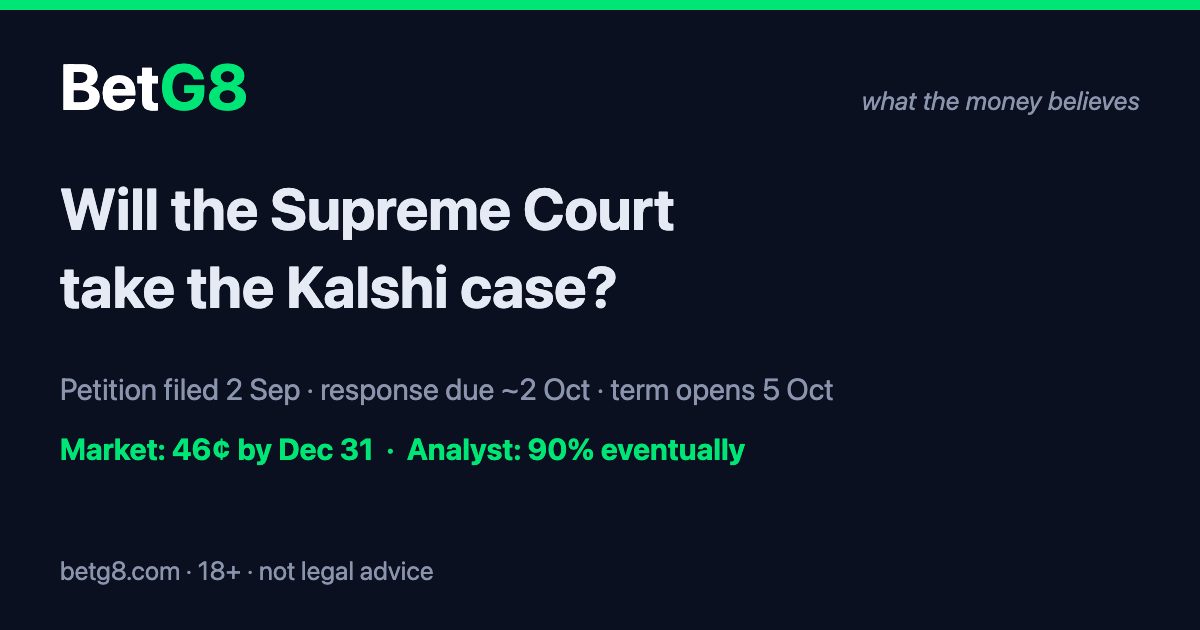
On Wednesday 2 September 2026, New Jersey Attorney General Jennifer Davenport filed a petition for a writ of certiorari asking the Supreme Court to review the Third Circuit’s April decision in Kalshi’s favour. The petition presents one question: whether the Commodity Exchange Act, as amended by Dodd-Frank in 2010, preempts states from regulating sports bets placed within their borders when those bets are offered on a CFTC-registered exchange. The filing came one day before an extended deadline New Jersey had already pushed twice, and five days after the Ninth Circuit ruled the opposite way in Nevada’s case (No. 25-7516).
The petition’s central claims, in the state’s own framing: Kalshi “built an entire business model on the claim that Congress silently displaced the States’ authority over sports wagering”; sports bets are not “swaps” as the statute uses the term; and if they were, every state-licensed sportsbook would have been violating federal law since 2010, because Dodd-Frank generally requires swaps to trade on CFTC-registered venues. It calls the Third Circuit’s decision “profoundly important” and “profoundly wrong”, and says the split “will determine whether a multi-billion-dollar gaming industry can suddenly operate free from state sports-gaming laws.”
Kalshi’s response, through spokesperson Dani Lever: the company “disagrees” with the filing, “remains confident in the lower courts’ rulings”, and “nothing in New Jersey’s filing today changes our view.” Its longer-standing position is that it is “an open, nationwide financial exchange” that “cannot be regulated by 50 different regulators.”
The timeline, with the dates that are fixed and the ones that are not
| Date | Event | Status |
|---|---|---|
| April 2026 | Third Circuit affirms Kalshi’s preliminary injunction against New Jersey; sports contracts are swaps, state law preempted. One judge dissents. | Done |
| 28 Aug 2026 | Ninth Circuit rules for Nevada: the relevant field is sports betting, not derivatives; state law not preempted. 3–0. | Done — creates the split |
| 2 Sep 2026 | New Jersey files the cert petition. | Done |
| ~2 Oct 2026 | Kalshi’s brief in opposition and any amicus briefs due, 30 days after filing. Kalshi can request an extension; New Jersey took two. | Deadline, extendable |
| 28 Sep 2026 | The Court’s first “long conference” of the term. The petition will not be ready for it unless Kalshi waives its response. | Fixed date, unlikely to matter |
| 5 Oct 2026 | October Term 2026 begins. Argument sittings run Monday–Wednesday through April. | Fixed |
| Oct–Dec 2026 | Earliest realistic window for the petition to be distributed to a conference and granted, denied, relisted, or sent to the Solicitor General. | Open |
| By ~mid-Jan 2027 | If granted by then, argument can be scheduled this term, with a decision by the end of June 2027. | Conditional |
| After mid-Jan 2027 | A later grant pushes argument to autumn 2027 and a decision into 2028. | Conditional |
The one date that is genuinely in play this month is the response deadline. If Kalshi asks for and gets a 30-day extension, the petition is not conference-ready until November. If the Court then calls for the views of the Solicitor General — plausible, because the federal government is itself a litigant against nine states on the same question — there is no deadline at all for that brief, and the calendar moves into 2027 before anyone votes on whether to hear it.

What the market says, and what it is actually pricing
Polymarket runs contracts on the Supreme Court accepting a sports event contract case by a given date. We logged the December contract hourly around the Ninth Circuit ruling in a separate data page; the short version is below.
| When | “SCOTUS accepts by 31 Dec 2026” | Note |
|---|---|---|
| 27 Aug close | 29–31¢ band | Day before the Ninth Circuit opinion |
| 28 Aug, 17:00 UTC | 29¢ | Opinion filed |
| 28 Aug, 18:00 UTC | 55.5¢ | +26.5¢ in one hour |
| 29 Aug, 00:00 UTC | 58¢ | Peak |
| 1 Sep | 51¢ | Day before the petition |
| 3 Sep | 46¢ | Day after the petition, as reported by InGame |
Read that last row carefully. The petition everyone expected was filed, and the price went down five points. That is not the market doubting New Jersey; it is the market doing arithmetic on the calendar. “By 31 December” requires a response, distribution, a conference and a vote inside sixteen weeks, with an extension request and a possible SG referral in the way. The October contract on the same question, which never moved on the ruling, closed at 11.5¢ on 28 August and had drifted to 5.5¢ by 1 September for the same reason: the deadline, not the merits.
Against that, gambling-industry analyst Steve Ruddock said on a 2 September webinar he puts the chance of the Court not taking the case at about 10%: a clear split, a federal-versus-state question, and “economic consequence in the hundreds of billions of dollars … over the course of a decade.” Constitutional law professor Bob Jarvis, quoted in the same InGame piece, noted the Court “has also been known to sit there and let things percolate in the circuits” and could deny this petition while taking a later one. Both can be right. A 90% chance of eventual review is consistent with a 46% chance of review being granted by year-end.
The four things the Court can do
Grant. The Court agrees to hear the case. Timing decides everything: a grant by mid-January means a decision by June 2027; later means 2028. A grant does not itself change the injunction picture on the ground — Kalshi keeps its Third Circuit win in New Jersey, Nevada keeps its Ninth Circuit win, and the state-by-state map on our tracker stays as it is until the opinion.
Deny. The split stands. The Third Circuit rule governs in Delaware, New Jersey and Pennsylvania; the Ninth Circuit rule governs in nine western states (we went through them one by one). Everywhere else, district courts keep choosing which appellate reasoning to follow, which is roughly what they have been doing: by our count the states had won nineteen of twenty-three injunction decisions before the Ninth Circuit ruled. A denial is not a ruling that Kalshi is legal, or illegal, anywhere.
Call for the views of the Solicitor General. The Court asks the federal government what it thinks. There is no deadline. The CFTC under Chairman Michael Selig has already sued several states on the preemption question, so the SG’s brief would almost certainly back Kalshi’s reading; that alone does not decide whether the Court grants. This is the outcome that stretches the calendar the most.
Hold. The Court sits on the petition while the Second, Fourth and Sixth Circuits rule in their own Kalshi cases, then grants the one it thinks is the cleanest vehicle, which may not be New Jersey’s. Jarvis’s estimate is that some of those opinions may not arrive until 2028.
What a decision would change
If the Court ultimately agrees with the Third Circuit, sports event contracts are swaps under exclusive CFTC jurisdiction, and the twenty-plus state suits, the cease-and-desist letters, the geofence orders in Nevada, Michigan and Washington, and the criminal charges in Arizona all fall away or have to be reframed as something other than gambling enforcement. State-licensed sportsbooks would then face the question New Jersey raised in its petition: if sports bets are swaps, what have they been offering since 2010?
If the Court agrees with the Ninth Circuit, states regulate sports betting on prediction markets the way they regulate it everywhere else. Kalshi would need a licence, or a geofence, in every state with a gambling law that reaches it. The CFTC’s own suits against the states would lose their premise. Kalshi’s non-sports markets — elections, economics, weather — are not before the Court in this petition and would be unaffected either way.
Either way, the Court is being asked to revisit ground it covered in Murphy v. NCAA in 2018, when it struck down the federal ban on state-authorised sports betting and left the choice to the states. Six of the nine justices who decided Murphy are still on the bench. Ruddock’s point on the webinar was that taking this case means those same justices entertaining the argument that a federal statute already on the books in 2018 had quietly federalised sports betting without anyone in Murphy noticing.
What this is and is not
It is a dated summary of a pending petition and the public prices on it. It is not legal advice, and it is not a prediction. Prediction market prices are thin on these contracts and move on calendar mechanics as much as on the law; treat the cents as a temperature reading, not a forecast. Whether Kalshi is available where you live today is a separate question from any of this and is answered state by state on the tracker; what has changed and when is in the change log. 18+.
FAQ
- When will the Supreme Court decide whether to hear the Kalshi case?
- There is no fixed date. Kalshi’s response is due around 2 October 2026 and can be extended by 30 days. After that the petition is distributed to a conference; the justices can grant, deny, relist, or ask the Solicitor General for views, which has no deadline. A decision on whether to hear it is realistic between October 2026 and early 2027, but could slip further.
- If the Court takes the case, when would it rule?
- A grant by roughly mid-January 2027 allows argument in the current term and a decision by the end of June 2027. A later grant pushes argument to the autumn of 2027 and a decision into 2028.
- What are the odds the Supreme Court takes the Kalshi case?
- The Polymarket contract on the Court accepting a sports event contract case by 31 December 2026 was 46¢ on 3 September 2026, down from a 58¢ peak on 28–29 August. Industry analyst Steve Ruddock put the chance of the Court eventually taking the question at about 90%. The two numbers measure different things: by year-end versus ever.
- Does the petition change whether Kalshi is legal in my state today?
- No. Filing a petition changes nothing on the ground. The Third Circuit injunction still protects Kalshi in New Jersey; the Ninth Circuit ruling still binds nine western states; every other state is where it was on 1 September.
- What is the question the Court is being asked?
- Whether the Commodity Exchange Act, as amended by Dodd-Frank, preempts states from regulating sports bets placed within their borders when those bets are offered on a CFTC-registered exchange. Underneath it is whether a sports event contract is a “swap.”
- Could the Court deny this petition and still decide the issue later?
- Yes. Kalshi cases are pending in the Second, Fourth and Sixth Circuits. The Court can deny New Jersey’s petition and grant a later one it considers a cleaner vehicle.
Sources
- New Jersey petition for a writ of certiorari, filed 2 September 2026 (PDF)
- NJ Office of the Attorney General — press release, 2 September 2026
- Ninth Circuit opinion, No. 25-7516, 28 August 2026 (PDF)
- InGame — “Here’s What’s Inside New Jersey’s Supreme Court Petition, And What Happens Next”, 4 September 2026 (Ruddock and Jarvis quotes; Polymarket 46% figure; conference dates)
- NOTUS — “New Jersey Takes Its Fight Against Kalshi to the Supreme Court”, 2 September 2026 (Kalshi statement)
- Washington Examiner — “New Jersey wants to bring prediction market Kalshi to Supreme Court”, 2 September 2026
- Supreme Court of the United States — FAQ (cases argued per term)
- BetG8 — hourly Polymarket data around the Ninth Circuit ruling (CSV)
Prediction market change log: every dated rule change, week by week →