Is Kalshi legal in Nebraska?
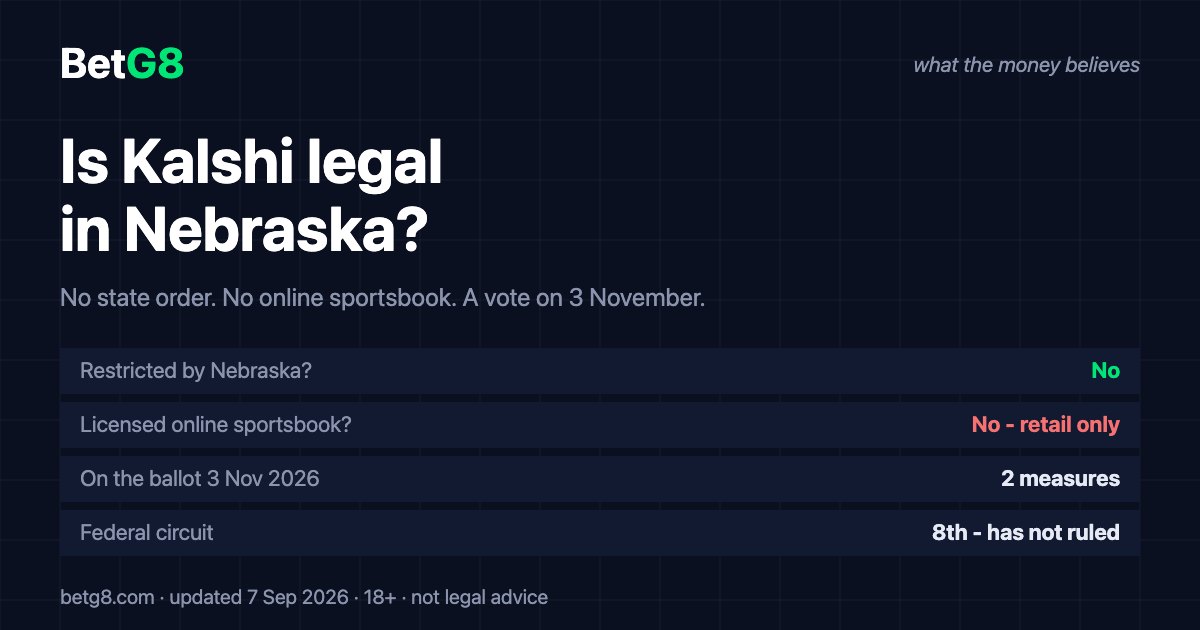
Nebraska at a glance
| Question | Answer as of 7 Sep 2026 |
|---|---|
| Is Kalshi accessible in Nebraska? | Yes. Kalshi operates nationwide as a CFTC-designated contract market. |
| Has Nebraska issued a cease-and-desist or sued? | No. AG Mike Hilgers has joined multi-state briefs in other states’ cases only. |
| Is there a licensed sportsbook in Nebraska? | Yes, but retail only — in person at licensed racetrack casinos since 2023. |
| Is online sports betting legal? | No. Nebraska is one of 19 states that still prohibits online gambling. |
| Which circuit binds Nebraska’s federal courts? | The Eighth (AR, IA, MN, MO, NE, ND, SD). Has not ruled; the Minnesota appeal sits there. |
| What changes next? | Two ballot measures on 3 November 2026 that would authorise and regulate online sportsbooks. |
Why Nebraska cannot simply send a letter
Most of the states now fighting Kalshi did it the same way: a gaming regulator with a statutory mandate sent a cease-and-desist, the exchange sued, and a federal judge decided whether the Commodity Exchange Act displaced state law. Nevada, New Jersey, Ohio, Maryland, Massachusetts, Connecticut and Washington all followed that shape.
Nebraska’s architecture is different. Article III-24 of the state constitution reserves the power to authorise new forms of gambling to the voters, which is why the 2020 expansion of casino gaming had to arrive as ballot measures rather than a bill. The Nebraska Racetrack Gaming Act then authorised sports wagering only in person, inside a licensed racetrack enclosure, and the Nebraska Racing and Gaming Commission never wrote online rules because it was never given the authority to. The criminal prohibition sits at Neb. Rev. Stat. § 28-1101, which defines gambling as betting something of value “upon the outcome of a future event” determined by an element of chance.
That statutory phrase is worth pausing on, because Kalshi’s product is literally called an event contract. The word that does the work for Kalshi is “chance”: the exchange’s position is that a contract priced by supply and demand between traders, with no house on the other side, is a derivative rather than a game of chance. Nebraska has never tested that argument in court, and unlike Nevada or Michigan it has no licensed online operator whose tax revenue is being undercut — the thing that has motivated almost every state enforcement action so far.

What Nebraskans are actually trading
Nobody publishes prediction market volume by state, because the platforms do not report it that way. What is published is volume by market, and the Nebraska-specific markets are large enough to be worth writing down. The Flatwater Free Press reported in March 2026 that Kalshi and Polymarket users had traded more than $97 million on Nebraska Cornhuskers men’s basketball games that season, and an average of $5.5 million per Husker football game the season before. Political markets ran smaller: a combined $1.4 million on the winner of Omaha’s “Blue Dot” congressional district in 2024, and $23,000 on the 2025 Omaha mayoral race.
How much of that is Nebraska money is unknown, and we would rather say so than estimate it. The number that is unambiguously local is the licensed one: Nebraska’s retail sportsbooks took in roughly $8 to $9 million of revenue in 2025, depending on the source and the period counted, against a 20% tax on gross gaming revenue. That is the entire regulated sports-betting economy of the state, and it is smaller than the reported trading volume on a single college basketball season’s worth of Husker contracts.
Nebraska’s casino industry has noticed. WarHorse Casino, run by Ho-Chunk Inc., the economic development corporation of the Winnebago Tribe of Nebraska, reported a 13% drop in Super Bowl wagering this year, though a spokesman noted the Chiefs’ 2025 appearance had inflated the prior-year base. WarHorse chief executive Lance Morgan called prediction markets “a loophole gone wild” and said he hoped the attorney general would issue cease-and-desist orders. Mike Sciandra, who directs the Nebraska Council on Problem Gambling, told Flatwater he sees no discernible difference between prediction markets and sportsbooks where addiction is concerned, and is already treating clients who use them.
The November vote, and who is funding it
On 21 August 2026 Secretary of State Bob Evnen certified both online sports wagering petitions for the 3 November ballot. The constitutional amendment needed valid signatures from 10% of registered voters — 127,054 — plus 5% of registered voters in 38 of Nebraska’s 93 counties; verification confirmed at least 138,473 and stopped there, because the state stops counting at 110% of the requirement. The statutory regulation initiative needed 88,938, or 7%, and was confirmed at 96,918. Raw submissions reported in June were higher: about 201,000 and 146,000 respectively.
The regulatory measure would let each licensed racino partner with a maximum of two online sportsbook brands. If voters approve, the Nebraska Racing and Gaming Commission would have until 1 June 2027 to write rules. The campaign, Tax Relief Nebraska, commissioned a study estimating just under $87 million in new state tax revenue over five years, with 70% directed to property tax relief — which is where the campaign’s name comes from, and why it is being argued as a tax measure rather than a gambling one.
Here is the part that makes Nebraska unusual. Campaign filings with the Nebraska Accountability and Disclosure Commission show FanDuel and DraftKings each committed around $3.5 million to the effort. Both companies launched their own sports prediction markets in the last year, and both currently reach Nebraskans through them. FanDuel has said it plans to stop offering sports prediction markets in states like Nebraska if those states legalise sports betting.
Read that sequence in order and it is a fairly clean piece of corporate logic: use the federal loophole while the state door is shut, spend to open the state door, then close the loophole behind you. The catch is that only the sportsbooks can execute the second half. Kalshi and Polymarket have made no commitment to withdraw from any state that legalises, and their entire legal position is that a state legalising or not legalising is beside the point. A yes vote in November would therefore convert FanDuel and DraftKings from prediction-market operators into licensed competitors of Kalshi — and give Nebraska, for the first time, a taxed industry with a reason to demand enforcement and a regulator with the standing to attempt it.
What changed in 2026
January — Hilgers picks a side, quietly. Nebraska Attorney General Mike Hilgers signed onto a legal brief supporting three California tribes — Blue Lake Rancheria, Chicken Ranch Rancheria of Me-Wuk Indians and Picayune Rancheria of the Chukchansi Indians — in their suit against Kalshi and Robinhood. He has since joined the bipartisan multi-state briefs arguing that Kalshi is disregarding state and tribal gambling authority. He has filed nothing in Nebraska, and his office declined to comment to Flatwater.
March — the loophole becomes a local story. Flatwater Free Press published the first detailed accounting of prediction market activity on Nebraska events, syndicated nationally through the Associated Press. It is still the only Nebraska-specific volume reporting we are aware of.
28 July — the Eighth Circuit gets a case. U.S. District Judge Katherine Menendez enjoined Minnesota’s prediction market ban four days before it was due to take effect, finding Kalshi, Polymarket and the federal government likely to succeed on preemption. Minnesota is in the Eighth Circuit with Nebraska. Whatever that appeal produces will be binding law in Omaha.
21 August — the ballot is set. Both petitions certified. State officials must certify the full ballot by 11 September, and the Secretary of State’s office will hold public hearings in each of Nebraska’s three congressional districts.
28 August — the split hardens elsewhere. The Ninth Circuit held that sports event contracts are not swaps, contradicting the Third Circuit’s April decision. Neither binds Nebraska. New Jersey filed its certiorari petition on 2 September; a Supreme Court ruling would.
How Nebraska compares to its circuit
| State | Online sportsbook? | Action against Kalshi | Eighth Circuit status |
|---|---|---|---|
| Nebraska | No — on the ballot 3 Nov | None; AG joined other states’ briefs | Bound, not litigating |
| Minnesota | No | Statutory ban — enjoined 28 Jul 2026 | The live appeal |
| Iowa | Yes | Regulator pushback | Bound, not litigating |
| Missouri | Yes | Limited | Bound, not litigating |
| Arkansas | Yes | AG opinion only, no suit | Bound, not litigating |
The Eighth Circuit is the quietest of the contested circuits, and Minnesota is carrying it alone. That produces an unusual asymmetry: Minnesota wrote the most aggressive state law in the country, lost the injunction fight, and will now generate the precedent that governs six neighbours who did nothing. Nebraska is the neighbour with the most at stake, because it is the only one of the six about to create a licensed online market.
What would actually change the answer
- Voters say yes on 3 November. This is the big one. Legalisation creates licensed operators, tax revenue and a regulator with rules to write by 1 June 2027 — in other words, the exact conditions that produced enforcement in every other state.
- Voters say no. The status quo hardens: prediction markets remain the only online option for a Nebraskan, with no state mechanism short of the criminal code to change that.
- The Eighth Circuit rules on Minnesota. Binding in Nebraska either way, and it would arrive without Nebraska having filed a single page.
- The Supreme Court grants review. New Jersey’s petition, filed 2 September, would settle the preemption question nationally. See our timeline of what a cert grant would take.
- Hilgers opens a file. Nothing prevents it today. What is missing is a licensed constituency asking for it — which November could supply.
Frequently asked questions
- Is Kalshi legal in Nebraska?
- Kalshi operates in Nebraska under CFTC oversight and, as of 7 September 2026, no Nebraska regulator, attorney general order or court order restricting it has been publicly reported. Attorney General Mike Hilgers has signed onto multi-state briefs against Kalshi in other states’ cases but has not issued a cease-and-desist or filed suit of his own.
- Can you bet on sports online in Nebraska?
- Not through a licensed sportsbook. The Nebraska Racetrack Gaming Act authorises sports wagering only in person at a licensed racetrack enclosure, and the state constitution reserves the power to authorise new forms of gambling to voters. Nebraska is one of 19 states that still prohibits online gambling.
- What is on the Nebraska ballot in November 2026?
- Two measures, both certified by Secretary of State Bob Evnen on 21 August 2026 for the 3 November ballot. A constitutional amendment would authorise laws permitting online sports wagering; a statutory initiative would set the regulatory framework, letting each licensed racino partner with up to two online sportsbook brands. If both pass, the Nebraska Racing and Gaming Commission would write rules by 1 June 2027.
- How much do Nebraskans trade on prediction markets?
- There is no state-level figure, because prediction markets do not report by state. The Flatwater Free Press reported in March 2026 that Kalshi and Polymarket users combined had traded more than $97 million on Nebraska Cornhuskers men’s basketball games that season and an average of $5.5 million per Husker football game the season before, though it is not known how many of those users were in Nebraska.
- Which federal circuit covers Nebraska?
- The Eighth Circuit — Arkansas, Iowa, Minnesota, Missouri, Nebraska, North Dakota and South Dakota. It has not yet ruled on sports event contracts, but the appeal of the July 2026 injunction against Minnesota’s ban sits there, and a ruling would bind Nebraska whether or not Nebraska ever litigates.
- Would legalising online sports betting remove prediction markets from Nebraska?
- Partly, and only voluntarily. FanDuel has said it plans to stop offering sports prediction markets in states that legalise sports betting, and DraftKings has signalled a similar posture. Kalshi and Polymarket have made no such commitment, and their position is that state law does not apply to them at all.
Sources
- Flatwater Free Press — Trading or gambling? How a new way to wager on sports is evading Nebraska’s betting ban (19 Mar 2026)
- SBC Americas — Nebraska online sports betting measure heads to November ballot (24 Aug 2026)
- Nebraska Secretary of State — certification of both online sports wagering petitions (21 Aug 2026)
- Nebraska Examiner — Measures to legalize, regulate online sports betting qualify for Nebraska ballot
- Ballotpedia — Nebraska Online Sports Betting Amendment (2026)
- Ballotpedia — Nebraska Regulate Online Sports Betting Initiative (2026), including campaign contributions
- Nebraska Legislature — Neb. Rev. Stat. § 28-1101, definitions
- Prediction News — California tribes sue Kalshi and Robinhood
- Courthouse News — Judge blocks Minnesota ban on prediction markets (28 Jul 2026)
- CNN Business — States can regulate prediction markets as gambling (28 Aug 2026)
A note on the numbers. Nebraska’s 2025 retail sports betting revenue is reported at roughly $8.1 million by industry data compilers and as “more than $9 million” by Flatwater; the gap is a matter of period and category definitions, and we have given the range rather than pick one. Trading volumes on Husker markets are platform-wide totals for those contracts, not Nebraska residents’ wagers, and should not be read as either.
We track every dated change to this picture in our prediction market change log, published as an open CSV.