Do sportsbooks make money from prediction markets?
The number that matters
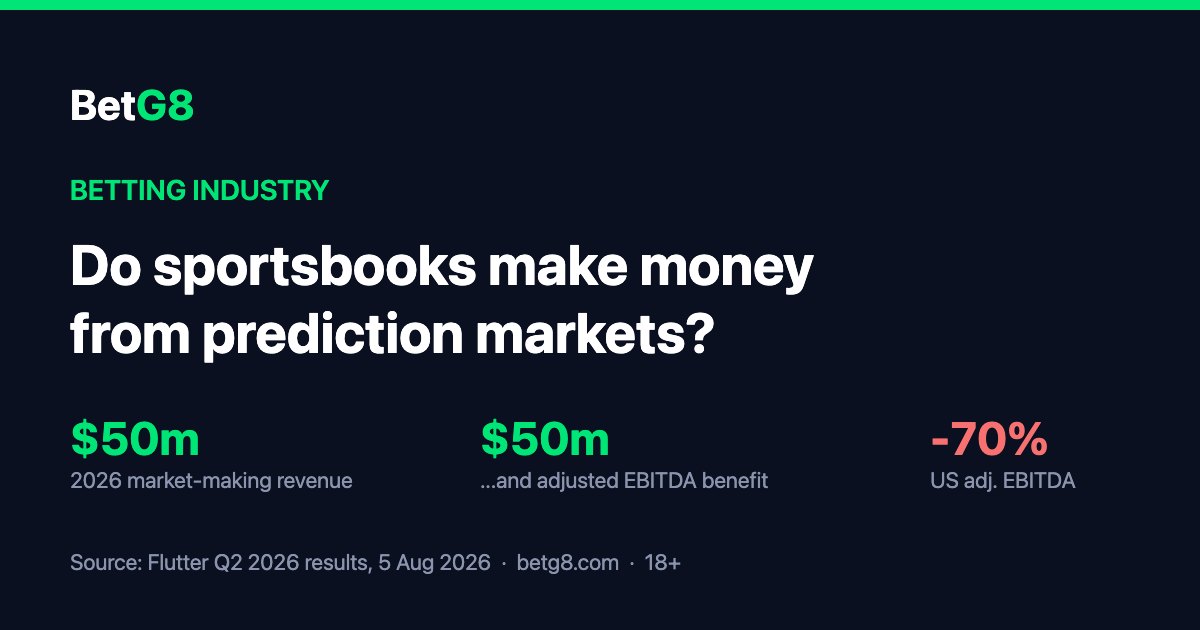
Buried in Flutter’s Q2 2026 guidance update is this line, quoted verbatim:
Revenue of $50m and an adjusted EBITDA benefit of $50m are the same figure. In plain terms, Flutter expects essentially all of that revenue to fall through to profit. There is no meaningful incremental cost line attached to it.
That makes sense once you see what market making actually is here. Flutter is not running an exchange and is not taking the other side as a bookmaker. It is quoting two-sided prices on contracts listed on someone else’s prediction market and collecting the spread between what buyers pay and sellers receive. The pricing models, the risk systems and the traders required to do that already exist — Flutter built them to run a sportsbook. Pointing them at a different venue costs close to nothing.

The number that gets the headlines
The same day, Flutter reported US adjusted EBITDA of $119m, down 70%. The release attributes the drop, in its own words, to performance “after prediction market investment and new state launch investment.” US full-year guidance was cut to $7.4bn revenue and $760m adjusted EBITDA — reductions of $395m and $210m against previous guidance.
So within one company, in one quarter, prediction markets show up twice with opposite signs. As a product Flutter operates, they are a cost heavy enough to be named in the explanation for a 70% profit decline. As an activity Flutter performs inside other people’s venues, they are a near-pure-margin $50m.
Flutter has declined to say which platforms it makes markets on.
Why this cuts against the usual framing
The standard story about sportsbooks and prediction markets is a territorial one: licensed operators pay tax and follow state rules, prediction markets do neither, and the sportsbook lobby is therefore funding the state-level legal campaign against them. That story is real and the litigation is real.
It is also incomplete. The largest US sportsbook operator is simultaneously earning the spread inside the venues the industry is fighting. Both things are true at once, and neither is hypocrisy exactly — providing liquidity on a CFTC-regulated exchange is a different act from operating an unlicensed sportsbook. But it does mean the incumbents are not simply trying to make the category disappear. Some of them are positioning to be paid by it either way.
What the two sides of the trade look like
| Running a prediction market product | Making markets on someone else’s | |
|---|---|---|
| Flutter’s 2026 economics | Named as a drag on a 70% EBITDA decline | $50m revenue, $50m EBITDA benefit |
| What you need | Licences, liquidity, users, regulatory exposure | Pricing models you already own |
| Who you compete with | Kalshi, Polymarket, Crypto.com, DraftKings | Quant firms and hedge funds |
| Legal exposure | The open question in several circuits | Materially lower |
| Ceiling | Potentially very large | Bounded by other people’s volume |
The last row is why nobody is abandoning the product side. A spread-capture business is capped by how much other venues trade. Kalshi handled roughly 83% of notional prediction-market volume in June, on reported figures — and on 26 August its Form D showed $1.12bn raised from 71 investors against a $1.5bn offering that opened on 3 April. Its May Series F valued the company at $22bn. Nobody raises that against a $50m-a-year spread business.
What to watch next
- Whether the $50m holds. It is guidance, given once, mid-year. Q3 is the first chance to see whether $6m a quarter compounds or plateaus.
- Whether Flutter names its venues. Market making on a venue your lobbying arm is suing is a position that gets harder to hold quietly.
- Whether DraftKings and Fanatics report the same line. If spread capture is near-pure margin for one incumbent, it is for all of them.
- Whether courts change the venue list. A Sixth Circuit ruling against Kalshi’s preemption theory would shrink the addressable volume that this whole trade depends on.
Frequently asked questions
- Do sportsbooks make money from prediction markets?
- At least one does. Flutter, FanDuel’s parent, reported $6m of market-making revenue in Q2 2026 and guided to $50m of revenue and $50m of adjusted EBITDA benefit for the full year. That is money earned by quoting prices on prediction-market contracts, not by operating a prediction market.
- What is market making in this context?
- Quoting both a buy and a sell price on a contract and collecting the difference. The market maker is not betting on the outcome; it is being paid to stand between buyers and sellers. Sportsbook operators are unusually well equipped for it because pricing events is already their core competence.
- Why are the revenue and profit figures the same?
- Because there is little incremental cost. Flutter guided to $50m of revenue and $50m of adjusted EBITDA benefit from the same activity, which implies the infrastructure and staff involved are already paid for by the existing sportsbook business.
- Is FanDuel Predicts profitable?
- Flutter has not published standalone profitability for it. What the Q2 release does say is that US adjusted EBITDA fell 70% to $119m after “prediction market investment and new state launch investment” — which places the product side on the cost ledger, not the profit one, for now.
- Does this mean sportsbooks have stopped opposing prediction markets?
- No. The state-level litigation and lobbying continue. The point is narrower: opposing a category in court and earning a spread inside it are not mutually exclusive, and at least one major operator is doing both.
- How big is the prediction market opportunity compared to this?
- Much bigger, if the category grows as its backers expect. Kalshi disclosed $1.12bn raised from 71 investors on 26 August 2026 and was valued at $22bn in its May Series F. A $50m-a-year spread business is not what that capital is underwriting.
Sources
- Flutter Entertainment — Q2 2026 financial results, 5 Aug 2026
- Flutter Entertainment — Q2 2026 earnings release (PDF)
- The Block — Kalshi Form D shows $1.12bn raised since April, 26 Aug 2026
- DeFi Rate — Flutter moves FanDuel Predicts sports contracts to Crypto.com
- The Lines — weekly prediction markets roundup
- SBC Americas — Kalshi in Sixth Circuit oral arguments
We track every dated change to this picture in our prediction market change log, published as an open CSV.