Can you bet NFL player props on prediction markets?
What one game actually looked like
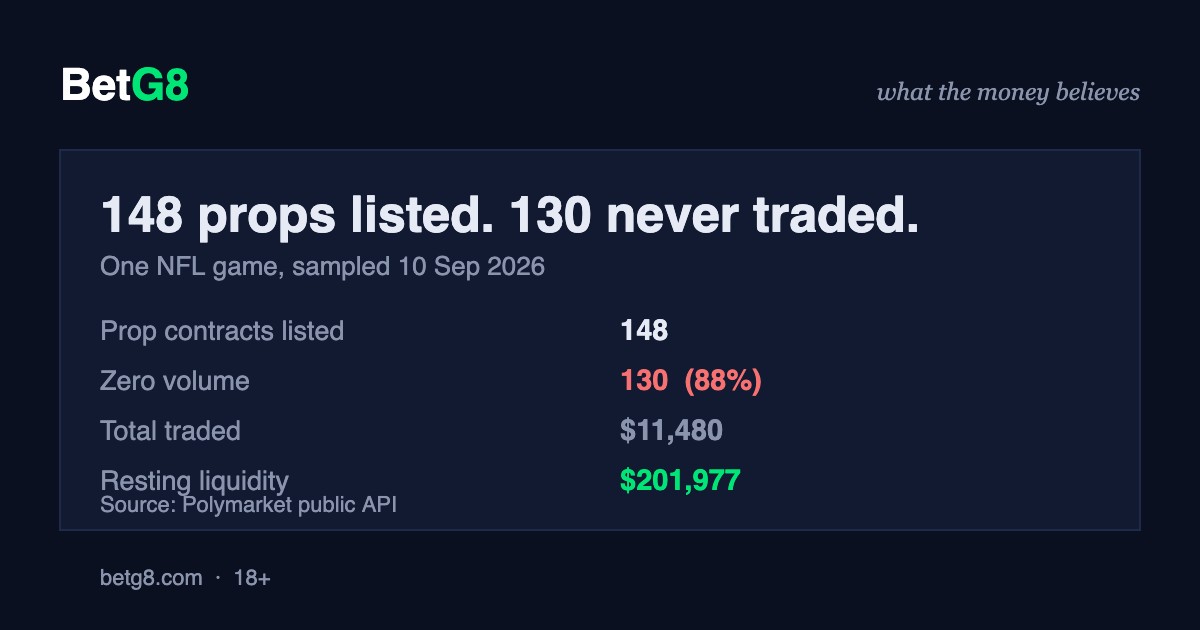
Sampled on 10 September 2026 from the Polymarket public API, covering two upcoming games:
| Player props Dolphins v Raiders, 13 Sep | Game markets 49ers v Rams, 11 Sep | |
|---|---|---|
| Contracts listed | 148 | 135 |
| Contracts with zero volume | 130 (88%) | 84 (62%) |
| Total traded | $11,480 | $555,956 |
| Resting liquidity | $201,977 | $5,398,668 |
| Liquidity to volume | 17.6x | 9.7x |
| Largest single contract | $8,912 (78% of event) | $247,345 (44% of event) |
The prop board was topped by Brock Bowers anytime touchdown at 7c with $8,912 traded. The second largest prop on the entire card was Michael Mayer anytime touchdown at $545. Third was $499. After that it falls to nothing.
On the game card the concentration is the same shape but less extreme. Spread -3.5 took $247,345 and the moneyline took $209,597, which is 82 percent of the game event between two contracts, leaving roughly $99,000 spread across the other 133.

What the liquidity-to-volume ratio is telling you
The prop event carried about $202,000 of resting liquidity against about $11,500 of traded volume. Somebody is quoting the whole 148-contract menu. Almost nobody is hitting those quotes.
That gap is the single most useful number on this page, because it separates two things that look identical on a screen. A price displayed next to a contract means a market maker is willing to transact. It does not mean anyone has transacted, and it does not tell you how much size sits behind the quote or how far the price moves when you take it.
A contract with zero traded volume and a tidy two-sided quote is not a market with a consensus view. It is one participant offering an opinion. Treat the 130 untraded props on that card accordingly.
Where the money actually goes
Prediction market NFL money is concentrated in a handful of large, simple, long-dated markets:
| Market | Traded volume |
|---|---|
| Pro Football: 2027 Champion | $51,645,329 |
| Pro Football: 2026 MVP Winner | $741,798 |
| 49ers v Rams (whole game event) | $555,956 |
| Dolphins v Raiders player props (whole event) | $11,480 |
The season-long championship market is roughly 4,500 times the size of a full game props card. That ratio is the real answer to what these venues are good at today. They are deep on questions that stay open for months and thin on questions that resolve on Sunday afternoon.
It also explains the naming. The venue lists these as Pro Football rather than by league name, because league marks are trademarked and an unlicensed venue avoids them. The contract is on the outcome, not on the brand.
How this compares to a sportsbook
A major sportsbook offers the same prop menu and does not need anyone else to take the other side, because the book is the counterparty. It sets a price, builds its margin into that price, and fills you. Thin interest in a prop does not stop you getting a bet on; it mostly shows up as a worse price and a lower maximum stake.
An exchange has no such backstop. If nobody is on the other side at a price you will accept, there is no bet. That is the honest trade-off: the exchange fee structure is generally cheaper than sportsbook margin, and on a market where 130 of 148 contracts have never traded, cheaper is not the binding constraint.
For the underlying cost comparison between the two structures, see sportsbooks versus prediction markets and the Kalshi and Polymarket fee breakdown.
Read the settlement text, not the label
Each prop contract carries its own written rule in the market description. The Kirk Cousins passing yards contract on that card, for example, states that it resolves Over if he records 150 or more passing yards in regulation and overtime combined, resolves Under below that, and settles on official league statistics.
Two things there are worth noticing. Overtime is explicitly included, which is not universal across sportsbooks. And settlement is tied to the official statistical source, so a post-game stat correction can matter. What happens if a player does not take the field, or if the game is suspended, is also written into each contract rather than inherited from a house rulebook.
We took the same approach with tennis, where the difference between a retirement and a walkover changes the payout completely: what happens to a tennis bet if a player retires mid-match.
How we measured this
All figures were read from the Polymarket Gamma public API on 10 September 2026, using the NFL tag listing and then the individual event records. Contract counts are the number of markets attached to each event. Zero-volume counts are contracts whose reported traded volume was zero. Volume and liquidity are the venue reported event-level and market-level fields, in US dollars.
This is a snapshot of two specific games three days and one day before kickoff. Prop volume rises as kickoff approaches, so these counts would look different on Sunday morning. The point is not that props never trade; it is that the listed menu is far larger than the traded market at the moment most people are looking at it.
Kalshi was not included. Its public API was not returning listings to us when this page was written, so nothing here should be read as a statement about Kalshi prop depth. The measurements are Polymarket only.
Full counts are published as a CSV: download the NFL prop liquidity capture (CSV). Reuse is fine with or without credit.
Frequently asked questions
Can you bet NFL player props on prediction markets?
Yes. Polymarket lists player prop contracts alongside each game — anytime touchdown, multiple touchdowns, passing and rushing yardage lines, and more. On the Dolphins against Raiders game scheduled for 13 September 2026 it listed 148 separate prop contracts.
Are prediction market player props liquid?
Mostly not. Of those 148 prop contracts, 130 had never traded at all when we sampled them on 10 September 2026. Total traded volume across the entire prop event was about $11,500, and a single anytime-touchdown contract accounted for roughly 78 percent of it.
Why is there so much resting liquidity but so little volume on props?
The prop event showed about $202,000 of resting liquidity against about $11,500 of traded volume, a ratio of roughly 18 to 1. Market makers are quoting prices on the full menu, but very few takers are hitting those quotes. Quotes on screen are not the same thing as a traded market.
Where does NFL money actually go on prediction markets?
Into a small number of large markets. The 49ers against Rams game event traded about $556,000, of which the spread and moneyline together were about 82 percent. The season-long Pro Football 2027 Champion market had traded about $51.6 million.
Do prediction market props settle like sportsbook props?
Each contract carries its own written resolution rule in the market description, stating the statistical source and how regulation and overtime are treated. Sportsbook prop rules vary by operator. Read the specific contract text before taking a position.
Why does Polymarket call it Pro Football rather than the NFL?
The event and market titles use generic naming such as Pro Football 2027 Champion rather than league branding. League names and logos are trademarked, and unlicensed venues generally avoid them.
Sources
- Polymarket Gamma API, NFL tag event listing plus the event records for slugs nfl-mia-lv-2026-09-13-player-props, nfl-sf-la-2026-09-11, and the Pro Football 2027 Champion and 2026 MVP events. Sampled 10 September 2026.
- BetG8, sportsbooks versus prediction markets.
- BetG8, tennis retirement and walkover settlement.
18+ only. Prediction market contracts and sports wagering carry real financial risk. This page reports what the order books looked like on one date; it is not legal, financial or betting advice, and it is not a recommendation to take any position. If gambling stops being fun, help is available at 1-800-GAMBLER.