What happens to a tennis bet if a player retires mid-match?
The rule, in the exchange own words
Every Polymarket tennis match market carries its resolution text in the market description. Here is the operative language, taken verbatim from the US Open ATP match market for Ben Shelton against Carlos Alcaraz, sampled on 9 September 2026:
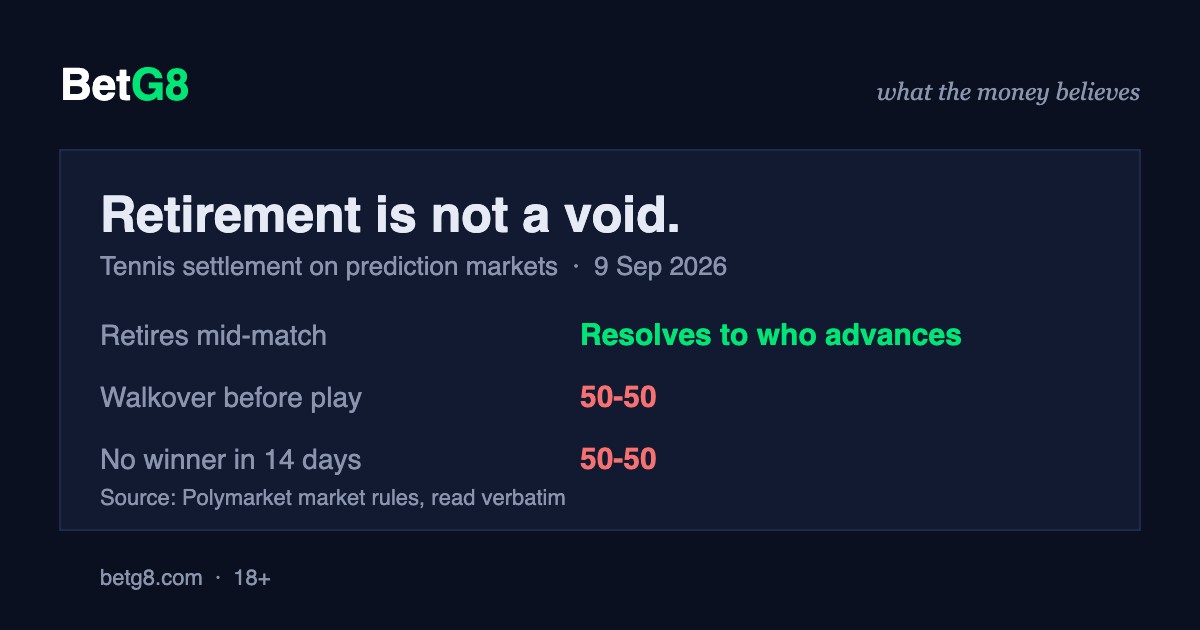
If the match begins but is not completed, and one player advances due to the opponent’s retirement, default, or disqualification, this market will resolve to the player who advances.
If the match ends in a walkover (player withdraws before the start and the other advances automatically), this market will resolve to 50-50.
If the match is canceled (not played at all), ends in a tie, or a winner has not been determined by [14 days after the scheduled start], this market will resolve to 50-50.
Three things follow from that. Play starting is the trigger that makes a retirement count. The 14 day clock means an indefinitely suspended match does not leave money locked up forever. And a 50-50 resolution is not the same as a void: both sides settle at fifty cents, so anyone who bought above fifty cents takes a loss and anyone who bought below it takes a gain.
Every scenario, and how it settles
| What happens | Did play start? | Polymarket match market |
|---|---|---|
| Normal completion | Yes | Resolves to the winner |
| Retirement mid-match | Yes | Resolves to the player who advances |
| Default or disqualification | Yes | Resolves to the player who advances |
| Walkover (withdrawal before play) | No | 50-50 |
| Match cancelled entirely | No | 50-50 |
| No winner within 14 days of scheduled start | Either | 50-50 |
The dividing line is whether the first ball was struck. That single fact decides whether a position pays in full or settles at half.

The contract that isolates the risk
Polymarket also lists a separate Completed Match contract next to the main market. Its rule, again verbatim from the same event:
This market will resolve to “Yes” if all games and sets required to determine a match winner under governing body or event organizer rules are played to completion through normal play. Otherwise, if the match is not completed for any reason, it will resolve to “No.” If a forfeit of any kind occurs, including but not limited to a walkover or retirement, this market will resolve “No.”
That contract exists because retirement risk in tennis is real and separable. In a sport where one player can end a match by walking to the net, the probability that a match finishes at all is its own question, priced separately from who wins it. Very little money trades there - the Completed Match contract on the Shelton match showed about a thousand dollars of volume against nearly six million on the match itself - but its existence is the clearest statement of how the exchange thinks about the problem.
Why a sportsbook may treat it differently
There is no single industry rule for tennis retirements. Operators set their own, and they differ on the crucial question of how much tennis has to be played before a match bet stands. Some settle on the player who advances as soon as the match begins. Some void unless a set, or a defined number of games, has been completed. Some apply one rule to the match winner market and a different one to set betting, games handicaps and totals.
The practical consequence is that a customer with the same view at two different books can end up with two different outcomes from the same retirement, and neither book has done anything wrong. Checking the specific house rule before the tournament is the only defence, and it is a different check at every operator.
The exchange approach is not automatically better. A 50-50 resolution on a walkover is a real loss for anyone who paid seventy cents, where a book that voids the bet would return the stake. The difference worth understanding is that the exchange publishes one rule in plain language per market, and it is the same rule for everyone holding that contract. For a broader comparison of the two structures, see sportsbooks versus prediction markets.
What the tennis markets look like right now
Tennis is no longer a marginal category on these venues. Sampled on 9 September 2026, during the closing week of the US Open:
| Polymarket market | Volume | Resting liquidity |
|---|---|---|
| 2026 Men’s US Open winner | $23.31M | $0.55M |
| 2026 Women’s US Open winner | $10.13M | $0.24M |
| Single match: Shelton v Alcaraz | $6.28M | - |
The outright books were priced as follows at the same moment. Men: Alcaraz 49c, Zverev 30.6c, Shelton 9.3c, Tiafoe 6.6c. Women: Sabalenka 37c, Gauff 20.6c, Rybakina 18c, Pegula 11c.
The tail matters more than the favourites for the purposes of this page. The men’s market listed 49 separate player contracts and the women’s 67. Most of those are players who have already been eliminated and trade at a fraction of a cent, and every one of them was, at some point in the tournament, exposed to the retirement question above.
Kalshi and the US Open
Kalshi signed a multi-year agreement with the United States Tennis Association to become the exclusive prediction market partner of the US Open, beginning with the 2026 tournament singles main draw on 30 August 2026. It is the first governing-body partnership of its kind in the sport and it arrived in the middle of the legal fight over whether sports event contracts are wagers at all.
Kalshi publishes its contract rules per market on the exchange, including how each series handles an unfinished event. Those rules should be read on the market page before trading rather than assumed from another venue, because the wording is not identical across exchanges and the difference between a resolution and a 50-50 split is the entire position.
Kalshi tennis contract text was not accessible from the public API at the time this page was written, so nothing above should be read as a description of Kalshi settlement terms. The quoted rules are Polymarket’s.
How we checked this
All quoted resolution language was read directly from the Polymarket Gamma API market descriptions on 9 September 2026, not from a help centre article or a third party summary. Prices, volumes and liquidity figures come from the same call, using last traded prices and the event level volume and liquidity fields. The Shelton match figures come from the event slug for that match; the outright figures from the men’s and women’s US Open winner events.
Resolution rules can be amended by the venue. The wording quoted here is what those markets carried on the sample date, and anyone relying on it for a live position should read the current text on the market page.
The scenario table and the price snapshot are published as a CSV: download the tennis resolution capture (CSV). Reuse is fine with or without credit.
Frequently asked questions
What happens on a prediction market if a tennis player retires mid-match?
The market resolves to the player who advances. Polymarket match rules state that if the match begins but is not completed, and one player advances due to the opponent retirement, default or disqualification, the market resolves to the player who advances. A retirement is treated as a result, not as a void.
What is the difference between a retirement and a walkover?
A retirement happens after play has started, when a player stops during the match. A walkover happens before play starts, when a player withdraws and the opponent advances automatically. On Polymarket a retirement resolves to the advancing player, while a walkover resolves 50-50, because the match never began.
What if the match is cancelled or never finished?
Polymarket match rules resolve the market 50-50 if the match is cancelled and not played at all, ends in a tie, or has no determined winner by 14 days after the scheduled start time.
Is there a separate market for whether a match finishes?
Yes. Polymarket lists a Completed Match contract alongside the main match market. It resolves Yes only if all games and sets required to determine a winner are played to completion through normal play, and No if a forfeit of any kind occurs, including a walkover or a retirement.
Do sportsbooks handle tennis retirements the same way?
No, and they do not all handle it the same way as each other. Retirement rules vary by operator and by market type, with some voiding match bets unless a set or a defined number of games has been completed. The exchange publishes one rule in plain text per market; a bettor comparing books has to read each set of house rules separately.
Does Kalshi offer tennis markets?
Kalshi is the exclusive prediction market partner of the US Open under a multi-year agreement with the United States Tennis Association, beginning with the 2026 tournament singles main draw on 30 August 2026. Contract rules on Kalshi are published per market on the exchange and should be read there before trading.
Sources
- Polymarket Gamma API, event slugs atp-shelton-alcaraz-2026-09-08, 2026-mens-us-open-winner-tennis and 2026-womens-us-open-winner-tennis, sampled 9 September 2026, for all quoted resolution text, prices and volumes.
- Reporting on the Kalshi agreement with the United States Tennis Association making it the exclusive prediction market partner of the US Open from the 2026 singles main draw on 30 August 2026.
- BetG8, sportsbooks versus prediction markets, for the structural comparison.
18+ only. Prediction market contracts and sports wagering carry real financial risk. This page explains how contracts settle; it is not legal, financial or betting advice, and it is not a recommendation to take any position. If gambling stops being fun, help is available at 1-800-GAMBLER.