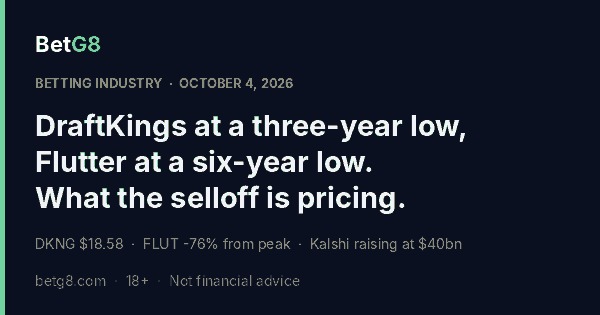
DraftKings at a three-year low, Flutter at a six-year low. What the sportsbook selloff is pricing.
The week in numbers
| Company | Price or value | Reference | Change | Source |
|---|---|---|---|---|
| DraftKings (DKNG) | $18.58 close, 1 Oct | Lowest close since April 2023 | About -50% over one year; -22% over one month | Legal Sports Report; Casino.org |
| DraftKings | $19.63 intraday low, 29 Sep | Peak $71.98, March 2025 | -72.3% from peak | InGame |
| Flutter (FLUT) | $74.39, 29 Sep | Lowest since March 2020 | -76.2% from August 2025 peak; -26% over one month | InGame; Northeast Times |
| Flutter market value | $12.9bn | Peak above $55bn | InGame | |
| DraftKings market value | $9.77bn | Peak $35.8bn | InGame | |
| Kalshi (private) | $40bn reported round valuation | $22bn at previous round | Raising $1bn | InGame; DigitalToday |
Market values are from the 29 September close and have moved since; the DraftKings figure in particular is lower after Thursday. The comparison that has travelled furthest this week is the simplest one: a private exchange founded in 2018 is being priced, by investors who are still negotiating, at roughly 1.7 times two listed operators that between them handle most of the regulated sports betting in the United States.
What is not driving the selloff
It is worth being precise about what the operating numbers say, because the stock charts invite a story the numbers do not support.
DraftKings told analysts at the Global Gaming Expo in Las Vegas that sportsbook handle was up 15% year over year through the first three weeks of September, and chief executive Jason Robins separately put NFL handle growth at 15% through week two. Its own yes/no exchange, DKeX, has had more than 600,000 customers try it, and turnover there is running at about 2.5 times the July level. Citizens analyst Jordan Bender wrote that companies at the show were "constructive on wagering trends exiting the World Cup."
So the top of the funnel is intact. The second-quarter revenue decline of 4.6% owes a good deal to sports results that favoured customers, which the company put at roughly $80m of lost revenue, a swing that reverses as often as it lands. Full-year revenue guidance of $6.5bn to $6.9bn would still be growth on 2025's $6.1bn.
Customers have not left. Investors have.

What is driving it: the cost of the second product
Three numbers explain most of the move, and all three are about spending rather than demand.
The quarter. DraftKings reported a second-quarter net loss of $67.6m against a $157.9m profit a year earlier. The core sportsbook is still guided to roughly $1bn of annual adjusted EBITDA, but the loss put a price on everything being built around it.
The prediction market budget. Management has said it plans "meaningfully greater investment" in prediction markets, and chief financial officer Alan Ellingson said that spending could run over two years. Citizens' Bender now estimates $450m to $500m of prediction market investment in 2026 and has cut his 2026 EBITDA estimate to $532m, 14% below 2025. Other published estimates sit at $200m to $300m. Either way the investment is being made from a position of weakness: in the NFL's opening week Kalshi took about 76% of sports event contract volume, and DKeX took about 3%.
The comparison. Robins described the dynamic himself: "We see a headline that is positive on predictions, and everyone in the company celebrates and our stock goes down." Every datapoint that suggests event contracts are a real market is read as a gain for the exchange that already leads it and a cost for the operators trying to catch up. That is the mechanism by which a $40bn private round moves two listed stocks.
Why the Kalshi number cuts both ways
A private valuation and a public market capitalisation are different objects. The $40bn is the price at which a small group of investors is prepared to buy a small slice of Kalshi, under terms that are not public and usually include preferences the common stock does not carry. The $23bn is the price at which anyone can sell all of DraftKings and Flutter this afternoon. Treating them as the same scale overstates the gap.
It also understates something. If the round closes, Kalshi will have raised $2bn in two rounds in under a year, with no public reporting obligations, and will be spending it against companies that have to explain every quarter why EBITDA fell. Fanatics, the third sportsbook, is private as well. Its chief executive Michael Rubin said on 2 October that the betting unit will spend up to $1bn on advertising in 2027, up from about $350m this year, "at the same level as FanDuel and DraftKings", and that being private means "no one's gonna push me to do anything we don't want."
That is the structural problem the market is pricing. Of the four companies competing for the American sports bettor in 2027, two are listed and two are not. The two that report are the ones whose spending is visible, and visible spending is what gets sold.
Flutter's extra problems
Flutter's fall is steeper than DraftKings' for reasons that are only partly about prediction markets. The company lost its Brazil licence in the same month it was shut out of India, and it put the Brazil cost at $70m of revenue and $20m of EBITDA. Its largest shareholder, Ken Dart, holds 31.4% bought for roughly $7.6bn, a position InGame estimates is about $6bn underwater. Flutter's disclosed net short positions stood at 5.18% as of 9 July.
The most interesting line in the Flutter research this week is not a price target but a survey. Citizens asked prediction market users why they used them. Better prices was the top answer at 35%, followed by better liquidity and no maximum bet limits at 31%, market availability and the ability to exit a position at 30% each, and preferring a trading experience at 29%. "Prediction markets may be competing with sportsbooks on more than their novelty," the analysts wrote. We have measured the price point ourselves and the answer is not uniform; our sportsbook versus prediction market comparison and the spread cost study are the relevant references. But if a third of users are leaving for liquidity and limits rather than price, that is a product gap, and product gaps are expensive to close.
Jefferies kept a $180 target on Flutter, 135% above the price. The distance between that target and the tape is the measure of how little the market currently trusts the spending plan.
What would change the picture
Three dates matter. DraftKings reports third-quarter results on 5 November 2026, and the prediction market line will be the first thing read. The Supreme Court is expected to decide whether to hear the Kalshi preemption case in the coming months, with argument in the spring if it does; the CFTC's two pending rules and the state injunction record set the range of outcomes. And Kalshi's round either closes at $40bn or it does not.
A ruling or a rule that pushes sports event contracts back under state gambling law would turn the incumbents' licences from a cost into the moat they were originally priced as. A ruling the other way makes the $450m a down payment. After the 2022 selloff DraftKings took 14 months to recover its losses, Bender notes, and he expects the stock to stay "range-bound" until there is clarity. Nothing on the calendar supplies that before November.
Method and limits
Prices and market values are as reported by Legal Sports Report, InGame, Casino.org and Northeast Times between 29 September and 2 October 2026, and refer to the dates given in the table; we have not pulled live quotes and the figures will have moved. Kalshi's valuation is a reported negotiating figure, not a closed round. Analyst estimates are attributed to the analysts who published them and are not ours. The Citizens survey is quoted as reported by InGame; we have not seen the underlying sample size or methodology.
Limits. We have no position in any company mentioned and do not give investment advice. Equity prices reflect many things beyond prediction market competition, including rates, the broader market and company-specific events such as Flutter's Brazil exit, and we have not tried to attribute the move between them. Nothing here is a forecast of where any stock, contract or company goes next.
Frequently asked questions
Why did DraftKings stock fall to a three-year low?
Three things landed at once: a second-quarter net loss of $67.6 million against a $157.9 million profit a year earlier, management signalling several hundred million dollars of extra spending on prediction markets, and a sector-wide reaction to Kalshi raising money at a $40 billion valuation. The stock closed at $18.58 on 1 October 2026.
Is Kalshi really worth more than DraftKings and Flutter combined?
On paper, yes. Kalshi is reported to be raising $1 billion at a $40 billion valuation. At the 29 September close Flutter was valued at $12.9 billion and DraftKings at $9.77 billion, about $23 billion together. A private round valuation and a public market capitalisation are not the same kind of number, which is part of why the comparison is contested.
Is sports betting handle actually falling?
No. DraftKings told analysts its sportsbook handle was up 15% year over year through the first three weeks of September. The selloff is about margins, spending and share of the next market, not about customers leaving today.
How much will DraftKings spend on prediction markets?
Management has guided to a meaningfully greater investment than before. Citizens analyst Jordan Bender estimates $450 to $500 million for 2026 and cut his 2026 EBITDA estimate to $532 million, 14% below 2025. Other analysts put the figure at $200 to $300 million. The company reports next on 5 November 2026.
What is Fanatics doing?
Fanatics CEO Michael Rubin said on 2 October that the company will spend up to $1 billion on betting advertising in 2027, up from about $350 million in 2026, to close the gap with DraftKings and FanDuel. Fanatics is private, so that spending does not show up in anyone's quarterly earnings.
Sources
- Legal Sports Report, DraftKings stock hits three-year low amid industrywide selloff, 1 October 2026.
- InGame, Flutter and DraftKings shares tumble further, hit lowest levels in years, 29 September 2026.
- Casino.org, DraftKings stock slumps, but prediction market spending could rise, 2 October 2026.
- Northeast Times, DraftKings shares near three-year low as company weighs more prediction market spending, 2 October 2026.
- RG.org, Fanatics plans up to $1B in gambling ads for 2027, Rubin says, 2 October 2026, reporting Bloomberg's interview with Michael Rubin.
- DigitalToday, Kalshi seeks funding at $40 billion valuation, 4 October 2026.
18+ only. This page reports public market prices, company statements and analyst research. It is not legal, financial or betting advice, and it is not a recommendation to buy or sell any security, trade any contract or place any wager. If gambling stops being fun, help is available at 1-800-GAMBLER.